At Home Challenges Recap

I know I haven’t been writing the blogs this year and I apologize for that. I hope everyone has still been able to get a good understanding of what has been going on through our general Wednesday meetings. In any case, since I don’t have a Wednesday meeting this week to recap, consider this a long overdue blog and progress report.

This last weekend we had our Infinite Recharge at Home Judged Component, Chairman’s, Dean’s List, Game Design, and Innovation Challenge interviews. With the exception of the Skills Challenges (and the additional Innovation Challenge submissions), we are essentially done with the season. So, without further ado, here is a “short” look at what we did for each challenge.

Infinite Recharge at Home

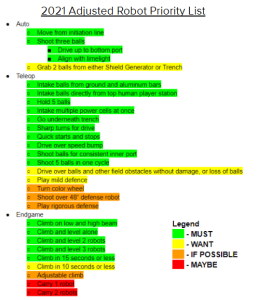
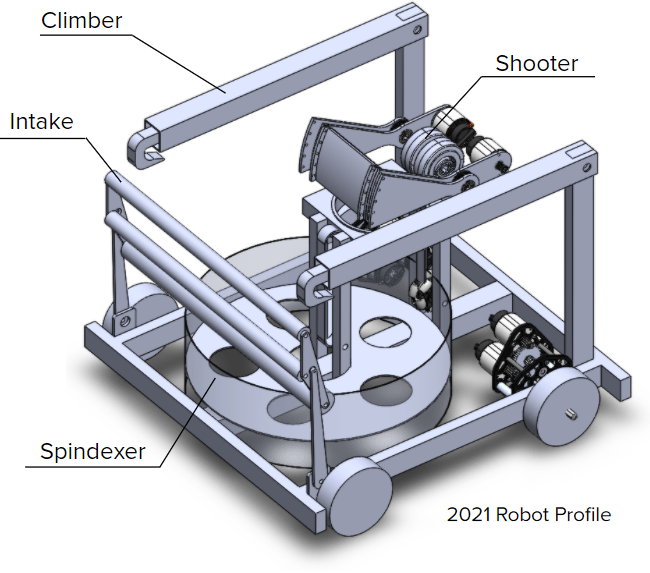
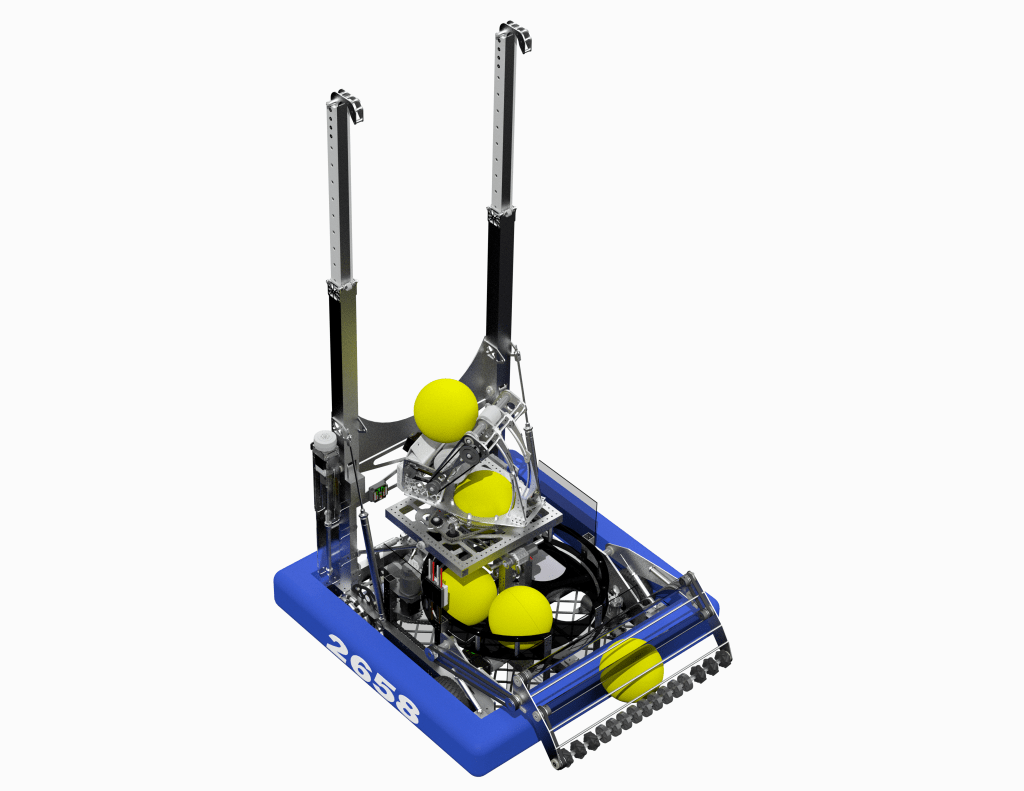
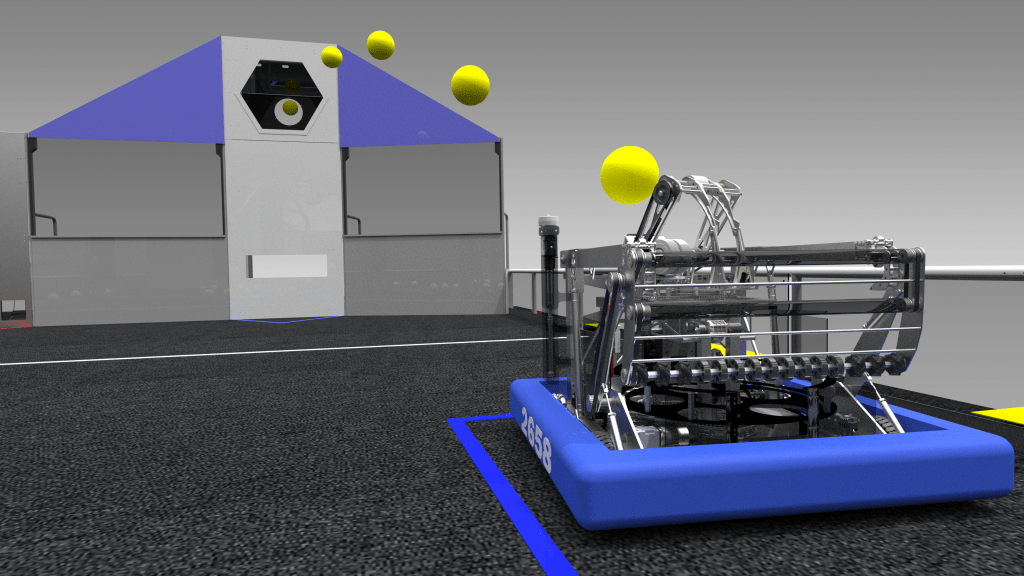
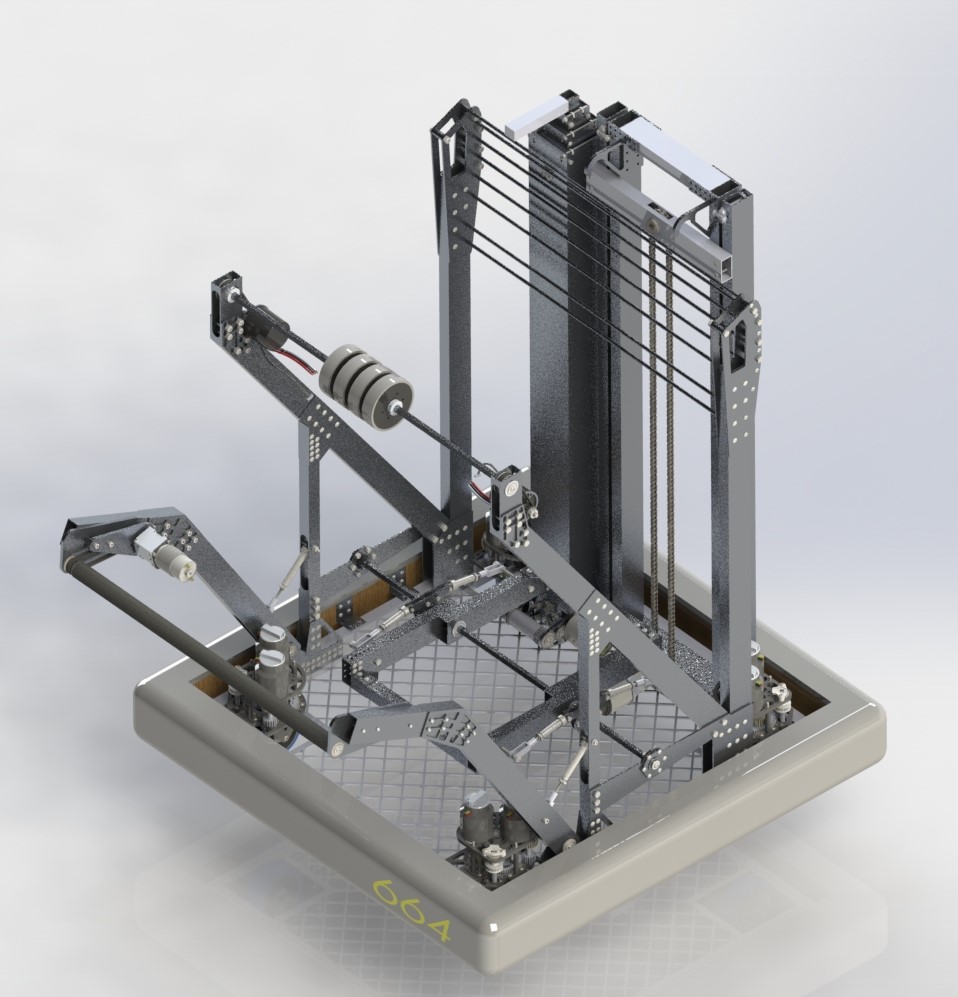
Ever since we knew we would play Infinite Recharge again, we knew a fundamental rebuild of the robot was necessary to significantly boost our performance. So, our design team set out to prepare just that. Starting from a restructured priority list we developed a completely different robot profile to play the game more efficiently.

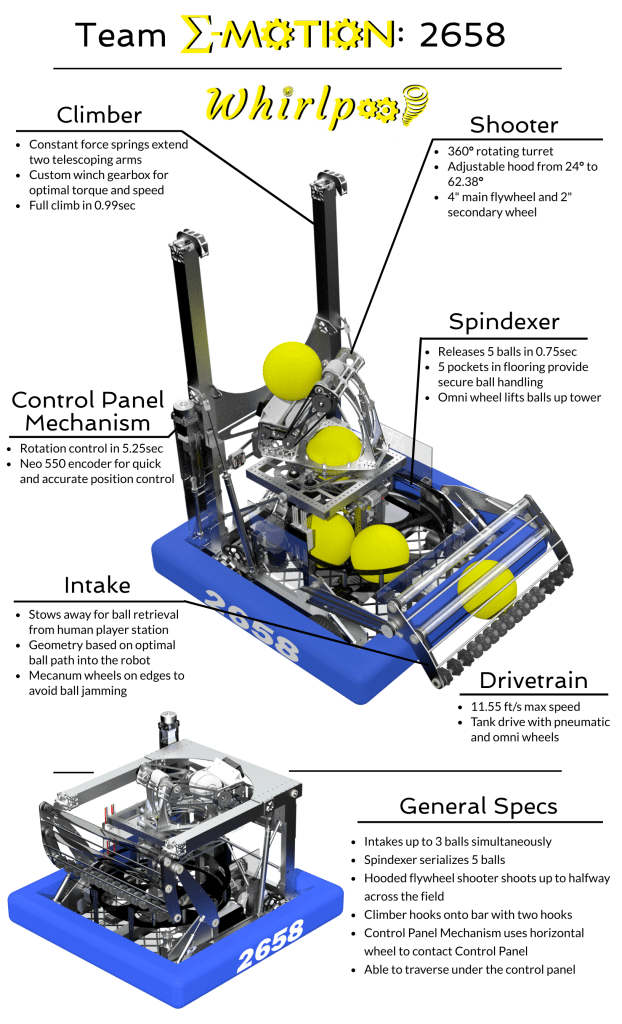
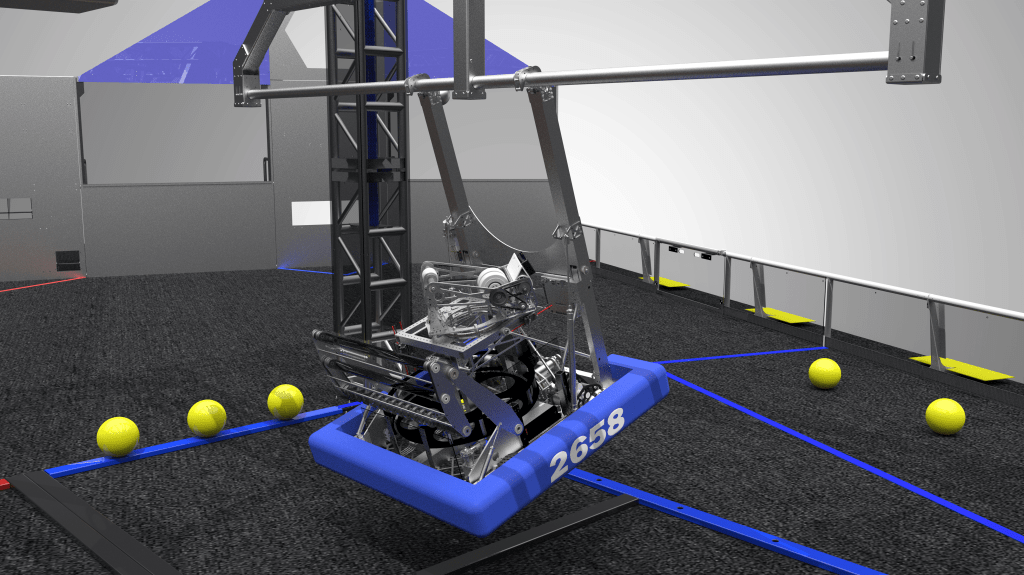
From this new profile we went through all the regular processes we go through each year to develop our robot, but with a few key tweaks. We did less prototyping because…well…pandemic. To account for that lack of data we instead did a heavy amount of review, redesign, and tweaking. What we normally only have 2 weeks to do during the season we now spent roughly 4-5 months on it, ensuring that every detail was accounted for. In the end, Whirlpool, our 2021 robot is what came out.

All in all, the thorough and extensive engineering process we underwent to not only develop the architecture for this robot but also the details and specificities of its mechanisms was exactly what this team can and should do to not only create stellar robots but, in the end, learn. I plan to write a series of blogs in the coming months going into more detail on some of these processes and what made Whirlpool such a great robot.

But, the most important thing going forward for this robot will be actually building it (once Covid gets just a bit better). This will not only allow you to crush it at off-season competitions if there are any, but will be perhaps the best training the team has ever gotten.

Game Design

Rather than just randomly put together a cacophony of ideas together to create a dismantled game, we set out from the beginning to figure out what makes a successful game. Through our analysis of the past 20 years of FRC games we came up with a list of principles that would serve as the fundamental structure for our game.

From that list we set out to figure out captivating and innovative elements of the game that would capture all of those elements. Each element was marked as to what principles it covered and, in the end, we found the right combinations of element ideas that were not only interesting and worked together but also hit each of the principles we needed.

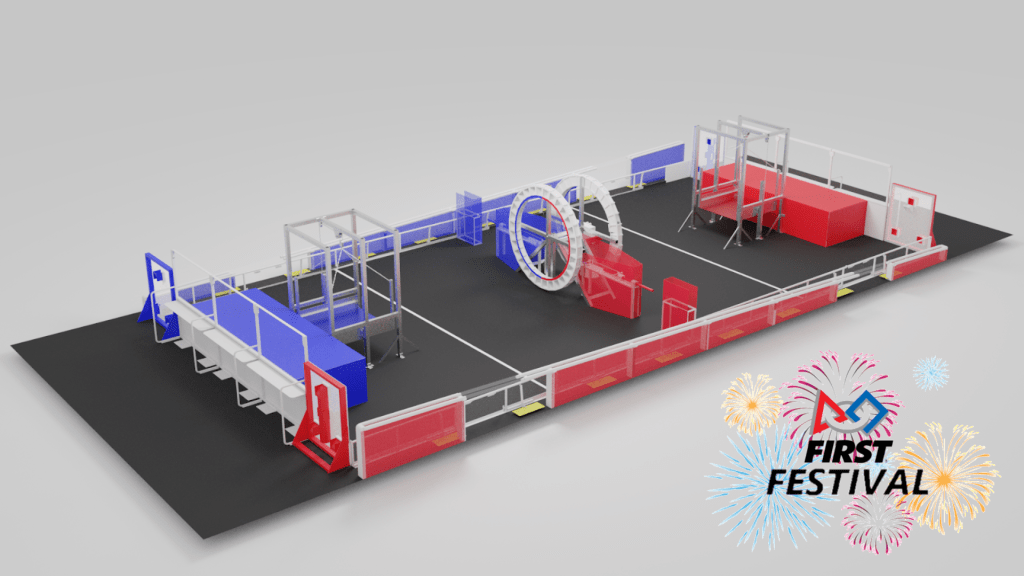
From there we set out to develop rules and a full CAD, ready to be built. What came out was FIRST Festival. You can see an overview of the game and how it works here. You can also see an animation of the gameplay here (this will be expanded and audio will be added soon)(also WordPress doesn’t let me embed videos anymore).

The field CAD and logo for FIRST Festival

Innovation Challenge

With our Innovation Challenge, we set out first to determine what problem in the world of fitness would be most appropriate to address. Through some market research and talking to experts, we finally settled on solving the problem of inadequate access to equipment for exercise. This was later grouped with lack of information as well.

After some more deliberation and plenty of ideas, we finally settled on Green Spot, a mobile application for finding nearby fitness equipment in parks as our Innovation Challenge solution. Users input their fitness goals and are provided with a list of nearby parks that have equipment to satisfy those goals. When looking at a park users can see what equipment they have as well and how to use it and even receive a workout recommendation based on that particular park’s equipment. Users can also communicate within groups with friends to find new parks and coordinate workouts.

You can see a general overview of how the app works here. In addition to actually developing the layout of the app, we also prepared a business plan and associated strategies to ensure that we could take the concept for Green Spot and make it a reality.

Tackling all three challenges (as well as the skills challenges) was always going to be a difficult task. But, nevertheless, this team was able to show its true strength by not only managing to finish all three but with flying colors as well. Our presentations and interviews with judges for all three showcased each brilliantly and the judges seemed eager for more. Although I do expect some awards for the hard work everyone has put in, it is still important to look back and enjoy the things we’ve created, the lessons we’ve learned, and the fun we’ve had. For those not working on the Skills Challenges, take a break and relax for a bit. We’ll be back at work soon enough don’t worry 🙂

The 2021 Season – Kickoff

It’s official, we’re on. The 2021 Season kicked off on January 9th and we met on Saturday (9th) and Sunday (10th) to explore the three different challenges: Game Design, Infinite Recharge at Home, and Innovation Challenge. After a thorough analysis, we have a concrete timeline and plan to proceed with, and specific ways in which we can maximize our effectiveness and success.

Game Design Challenge

While we’ve known for a while now that the challenge would be to design our own game, the specifics and constraints of that challenge is what we got at kickoff.

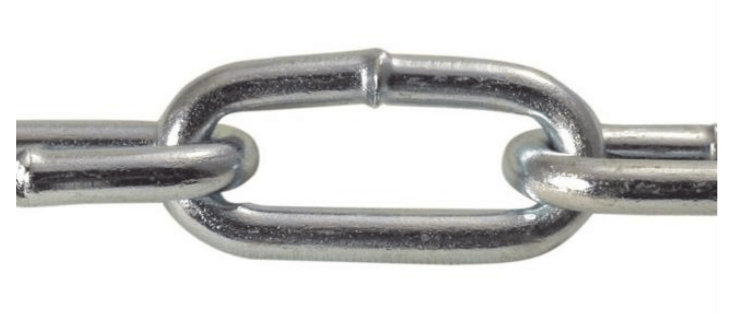
The most notable of these constraints is the use of chain for the game. While it’s not required to use the chain, it is necessary for the Concept Award (the award given for best overall game). Since we are striving for the best (always) it’s necessary for us to include the chain element. It does not say in what way we must incorporate this chain, but simply that it must be in our design somehow.

A photo of the chain that we must somehow incorporate into our design.

In addition to this element, there are restrictions on how large the field and robot can be. But, aside from these quite broad restrictions, we have a lot of versatility to create the game we wish to create. There are many aspects that go into creating an effective game – some that we’ve talked about at meetings and others that we haven’t yet – and therefore we’re allocated a fair bit of time at the start of the season to account for all of these aspects in our creation of the idea for the game. I will probably write an entirely separate blog about previous game designs and what we can learn from them in designing our own.

Once we’ve finalized the idea and game concept, we will proceed by developing a detailed field CAD, scoring guide and breakdown, and forming our essays in such a way as to effectively present the idea.

Infinite Recharge at Home

While we likely won’t be playing Infinite Recharge at competitions any time soon (if at all), FIRST has created an interesting alternative that should be plenty of fun nevertheless. The first element of the Infinite Recharge at Home challenge is the judging process, wherein we will present our robot and its features (as if at a normal competition). While there is some preparation to be done for that – mostly to do with getting the presentation perfected – the real preparation will come for the Skills Challenge. To allow teams to perform this challenge on their own, FIRST has made a “field” (30’x15′ zone) with various markers on the floor in which the robot will demonstrate its capabilities.

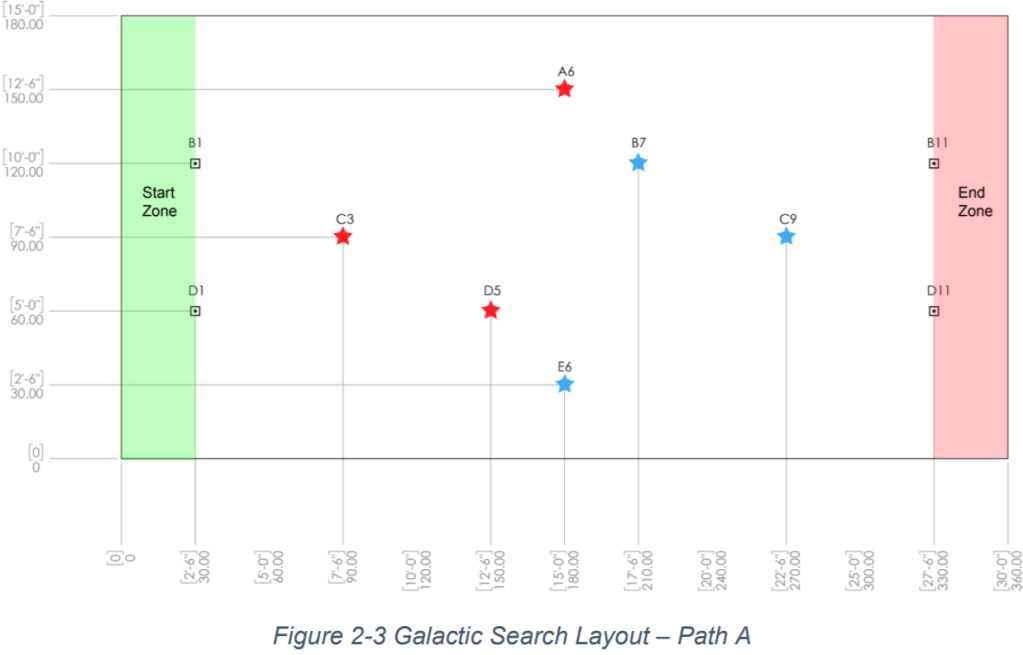
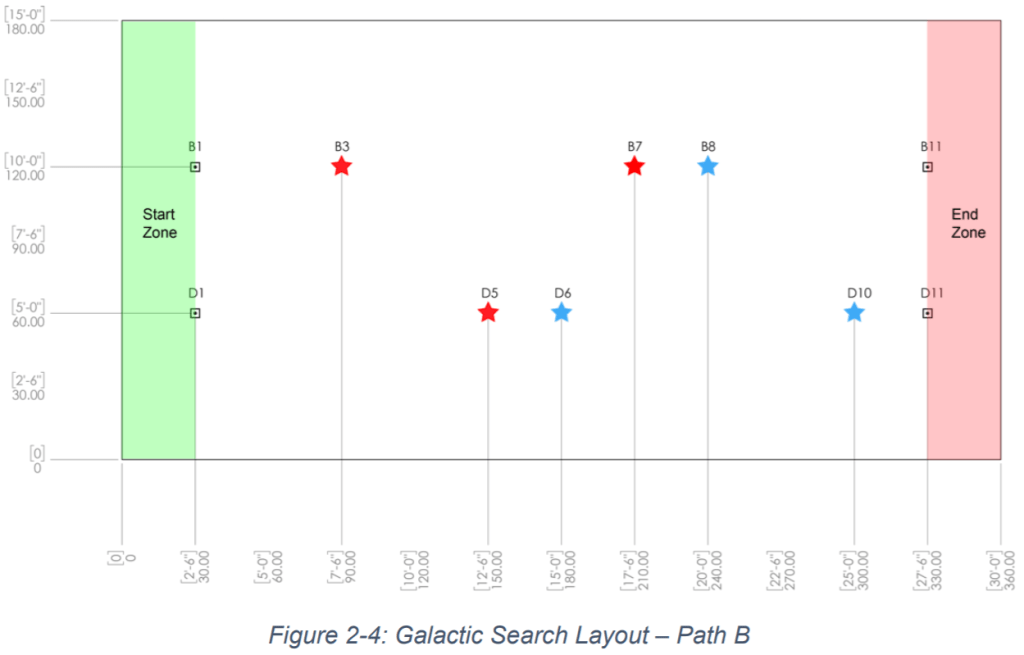
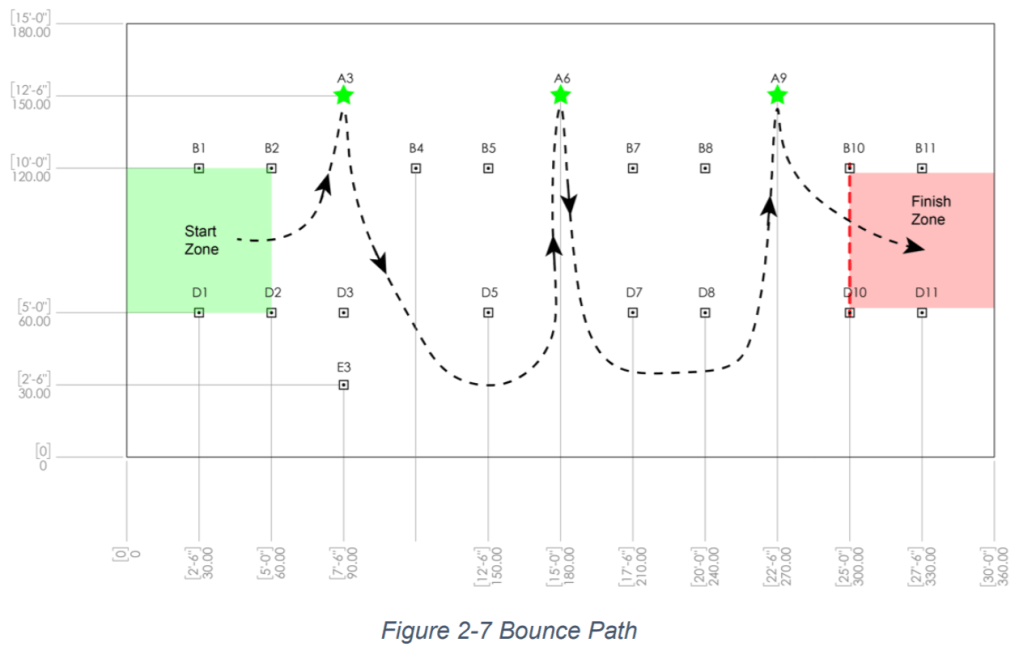
There are five sub-challenges, and the top three scores from those five count towards placement and the possibility of the winner and finalist awards. In the “Galactic Search” Challenge, teams autonomously grab three balls from two separate paths on the field. Scores are based on how fast the paths are executed. The two paths look like this on the field:

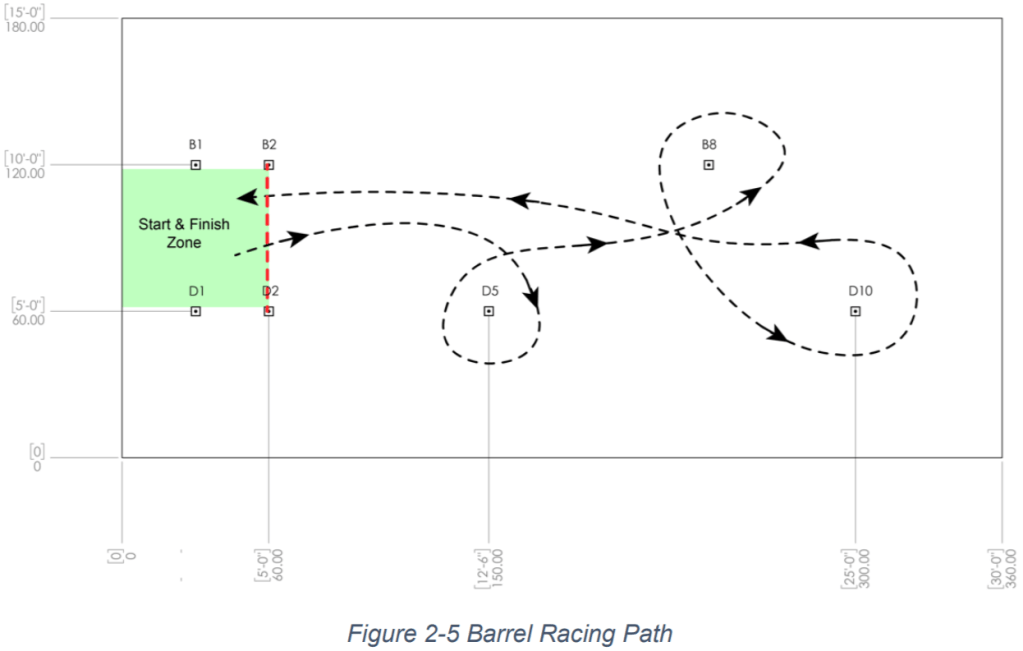
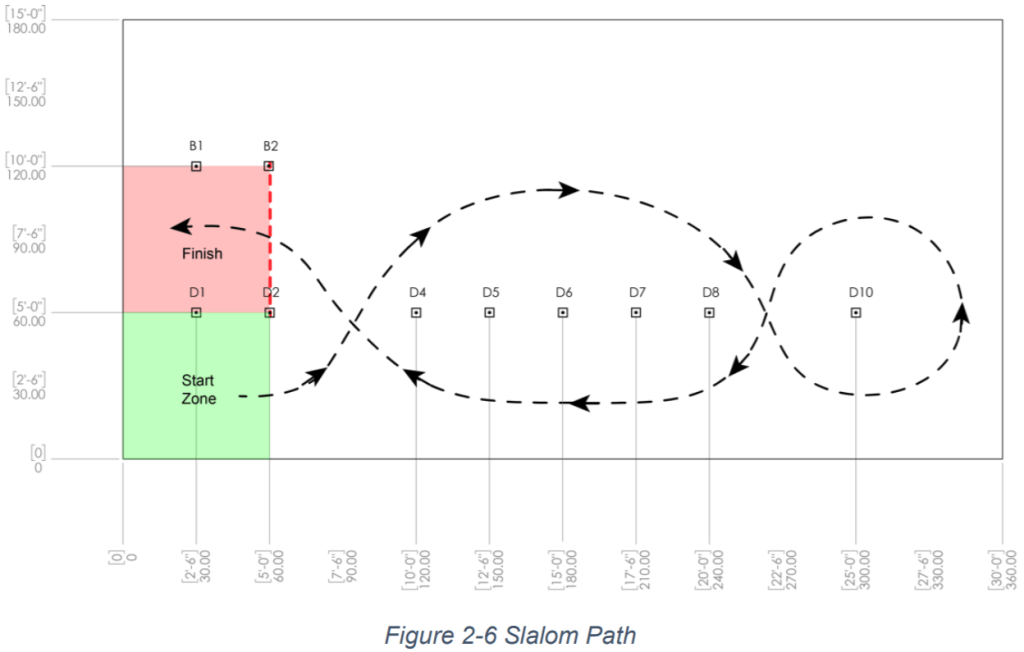
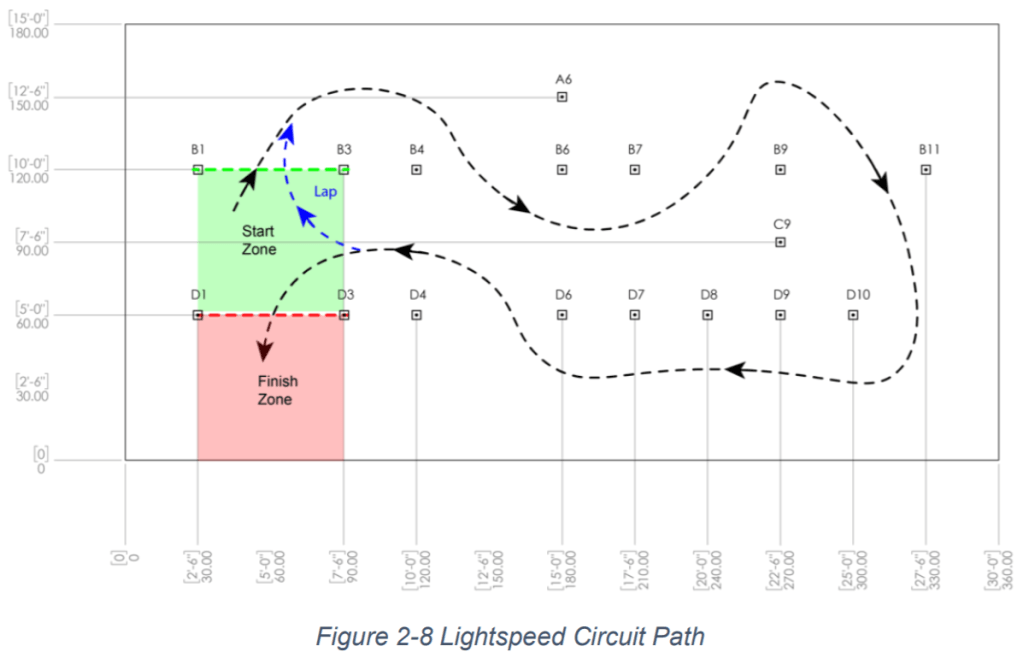
The “AutoNav” Challenge also tests autonomous by simply running various paths through the field and going for the fastest time. Those paths look like this:

In the “Hyperdrive” Challenge, essentially the same thing as the “AutoNav” Challenge happens, except that this time it’s teleoperated by our drive team. There is, in addition, one extra path to run that looks like this:

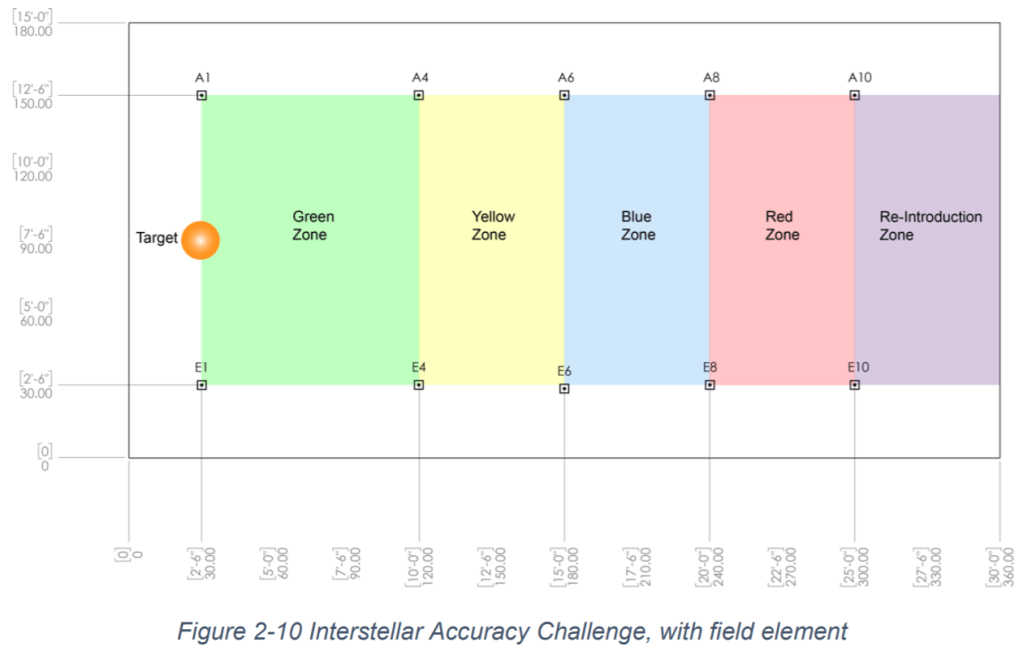
The “Interstellar Accuracy” Challenge is not based on time, but rather on how many points the robot can score from 15 shots (3 shots from each of the different color zones) in 5 minutes. The field layout for this challenge looks like this:

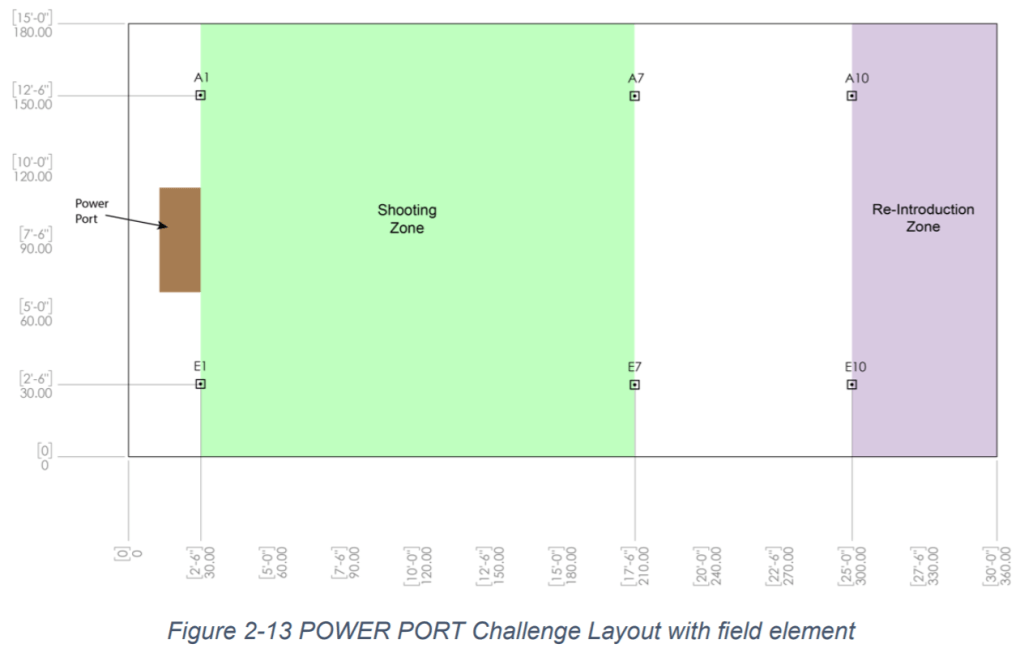
And finally, the “Power Port” Challenge simulated the teleoperated period by having the robot score as many points in the power port in one minute (while only cycling 3 power cells). The layout for the field looks like this:

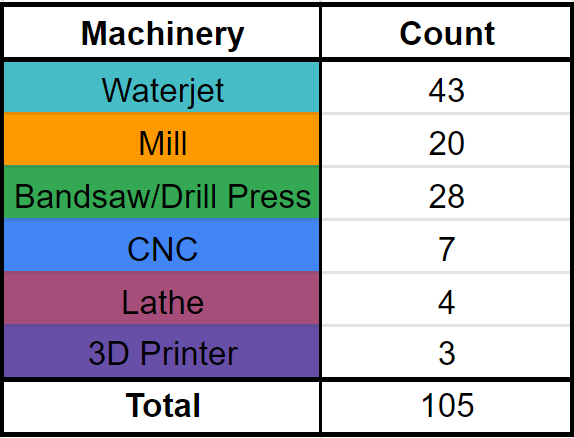
These are quite a bit of things to do. When looking at the skills required to be extremely successful in these challenges (which we want to do), it seems like Torpedo might not be the best possible robot. I say that mainly because of its drivetrain. Because of the length and imbalance with that drivetrain, quick, accurate maneuvers are more difficult to execute effectively. However, the shorter drivetrain – and improved shooting capabilities among other things – of the new robot designed would give it a significant edge for our challenges. If we were to build the second robot, the breakdown of the pieces to be built, and machinery for each is as follows:

There is quite a bit of work to do if we build a new robot, but the main issue with that plan is the safety of everyone. We will continue analyzing the situation each day and exploring the possibilities of either building a new robot or simply preparing Torpedo for the Skills Challenge. Ultimately, I think the situation with Covid is going to be the deciding factor in our ability to actually execute the significant improvements on the new robot over Torpedo. However, even if we don’t build the new robot, there is plenty Torpedo can do and still win our event.

That duality of possible situations is reflected in our timeline in the form of two separate plans that illustrate how we would act for building a new robot, improving Torpedo, and both. The timeline uses February 1st as a possible re-opening date to go to school, despite the current PUSD timeline that says January 19th (in anticipation that the current PUSD timeline might change).

No matter whether we build a new robot or not, we have a very good chance at not only winning the Skills Challenges but also perfecting our pitches and presentation in order to win some of the other awards as well. With the right attention to details and execution, this season should be even more successful than the last.

Innovation Challenge

The Innovation Challenge is similar to the Game Design Challenge in that it affords a considerable amount of creativity and freedom. Really, the only constraint around the Innovation Challenge is this statement: “Identify a problem or opportunity and design a solution to help people (or a community of people) keep, regain, or achieve optimum physical and/or mental health and fitness through active play or movement.”

With that central core concept in mind, the weekend was mainly spent brainstorming various problems and opportunities to explore. In the end, we narrowed it down to the following problems into which we want to delve more:

  • Lack of motivation and getting motivated to be active
  • Regaining motivation after, recovering, and preventing injuries
  • Keeping track of how your activity relates to nutritional goals
  • Promoting mental health through active movement
  • Incorporating activity in people’s daily lives
  • Changing mentality and approach to working out from “big” to “incremental” and “consistent”
  • Improving access to and affordability of equipment

Over the week we will talk to experts, research previous market solutions, and explore possible future market solutions in order to narrow down this list and finalize one problem. Once we have that problem finalized, our specific solution to that problem will be developed and decided as well.

Once we know exactly how we plan on solving that problem, our time will be spend evolving that solution design and preparing a business plan to effectively describe our idea and its applications and feasibility. Because of the considerable weight placed on the quality of the idea itself, we plan to spend a good amount of time in the beginning (now) coming up with a robust idea.

Timeline

In order to have an organized and effective season, we want to create and adhere to a concrete timeline that keeps us on the path to success. The following timeline has been created based on the discussions that occurred this weekend and gives a representation of what the team will be doing at any given time. The blue section describes the timeline for the Game Design Challenge. The green section gives general Infinite Recharge at Home tasks that will happen no matter what. The orange and purple timelines are two alternates depending on whether we build the new robot or not. The hope is that we will able to determine as soon as possible which one of these two timelines we will be adhering to. The red section details the timeline for the Innovation Challenge. If there are any questions, concerns, or comments on the timeline, as always, feel free to give feedback to the leads and execs so we can adjust accordingly.


Well, that has been a brief – but also not so brief – overview of the different challenges and what we will be doing this season. The full manual can be read here for more information on all of these challenges. Blogs will be a lot more regular (I want to say almost every day if not every day) and there is hopefully plenty of work for everyone to do so everyone can have fun. If we all work together, create thoughtful and effective designs and ideas, and focus on perfecting the tiniest of details, we can have a very successful season filled with good times. Here’s to another great season!

✌️

Some Progress

As we finish up the final couple weeks of school, we’re also looking to preparing the team as much as possible for the season to come. Since the last update, we have some more progress both on Torpedo and on the new robot (we should start thinking of names for it).

Some of the fundamental software changes needed since March have finally been implemented and are working their “magic”. We tuned PID on Torpedo’s shooter wheels and were able to achieve some considerably more accurate shots that provided a glimpse of the full potential of this robot. This was mostly tested with auto line shots — which generally tend to be easier to consistently get in — but some trench shots showed some of the downfalls.

One cycle of 5 balls with the PID implemented.

It may be difficult to notice in the video, but when looking at it in-person and specifically tracking where the balls are hitting each time, the spread is considerably lower than before.

With ball consistency now handled, we can move on to addressing accuracy each time. This will be done by using the Limelight vision system to track the target and rotate the drivetrain and tube angle to accurately shoot the balls. Right now we rely on human side-to-side alignment and pre-set positions for angles of the tube for various placements on the field. Although this works well, it yields some error and, more importantly, is quite slow.

Torpedo shooting 5 balls from the trench into the top port.

While it may be difficult to notice, all the balls in this video actually entered the top port. But, because of the angle and speed at which they entered, we rarely are able to get all 5 in from the trench and most of the time at least one ball bounces out. This can be avoided by properly using vision systems to adjust our shot and shoot the balls with the same velocity in the right part of the port, or with a different velocity and a different part of the port. In any case, precision of this kind cannot be done by the drivers. Hopefully we will be able to get these automated system running and tuned by the time the season starts.

Simultaneously, our drive team has been able to have more practice with Torpedo and the progress is definitely noticeable. Driving has gotten a lot smoother and cycles keep getting faster and faster. Moving the climbing bar outside has allowed us to integrate climbing into the driver practice sessions and that has led to an improvement in climbing speed and consistency from the last drive team.

The robot climbing on its low hooks on the bar outside.

That video shows the first step to a much faster climbing execution that should be very useful for competition or the skills challenge. But, overall, great improvements in the driving make the robot better each day. Hopefully once those fundamental software improvements are implemented, our drivers can get even more time to perfect their form.

By constantly improving and perfecting Torpedo, we are not only learning more and pushing its capabilities, but we are also setting up a backup plan of sorts. Because of the pandemic, it is uncertain how often, for how long, and when we will be able to meet to build a new robot. Therefore, incrementally improving the software and driving of Torpedo also prepares us for the worst to come in 2021 in addition to teaching us some great lessons about engineering.

There has also been some progress with the new robot as it slowly comes together. We’ve been doing incremental design reviews on the new changes being made and are able to start focusing on some smaller stuff for the climber, drivetrain, and intake. We’ve also had the initial structures and framework of the spindexer completed and the transition to the shooter is on its way as well.

The bottom panel of the spindexer that will rotate the balls and serialize them.

Within the next month these developments will all come together and we will hopefully begin making detailed drawings for parts to be made. The goal is to be completely done with the robot by the end of 2020 and we seem to be right on track to get there.

Finally, I have one small note. We made a new “exhibition” of sorts in the build room by displaying our 2019 intake iterations on the wall. This highlights the 7 different iterations of the intake plate that we tested and went through (there might be more but this is all I could find). It’s a cool visual but also shows the importance of iterative improvement. Our intake was not great in the beginning and was barely doing its job at our first regional. But, by persisting and making it better and better (even completely changing our hatch mechanism for the second regional), we were able to iteratively find a systematic solution to the problem. This is a cool visual, but there is meaning behind it and the iterative and systematic thinking portrayed in this display should continue to be embraced by the team. Enjoy. 😁 

The display of our 2019 intake iterations in the build room (oldest to newest from left to right).

You can see all the photos and videos from the off-season here.

✌ 

Some Updates

It’s been a while since I’ve written a blog. But, that doesn’t mean our time has been devoid of progress. We started our weekly Wednesday meetings and have been doing some training for teams that can do it virtually. Simultaneously, we’ve been working on both improving Torpedo (our 2020 robot) and developing the design for our potential 2021 robot.

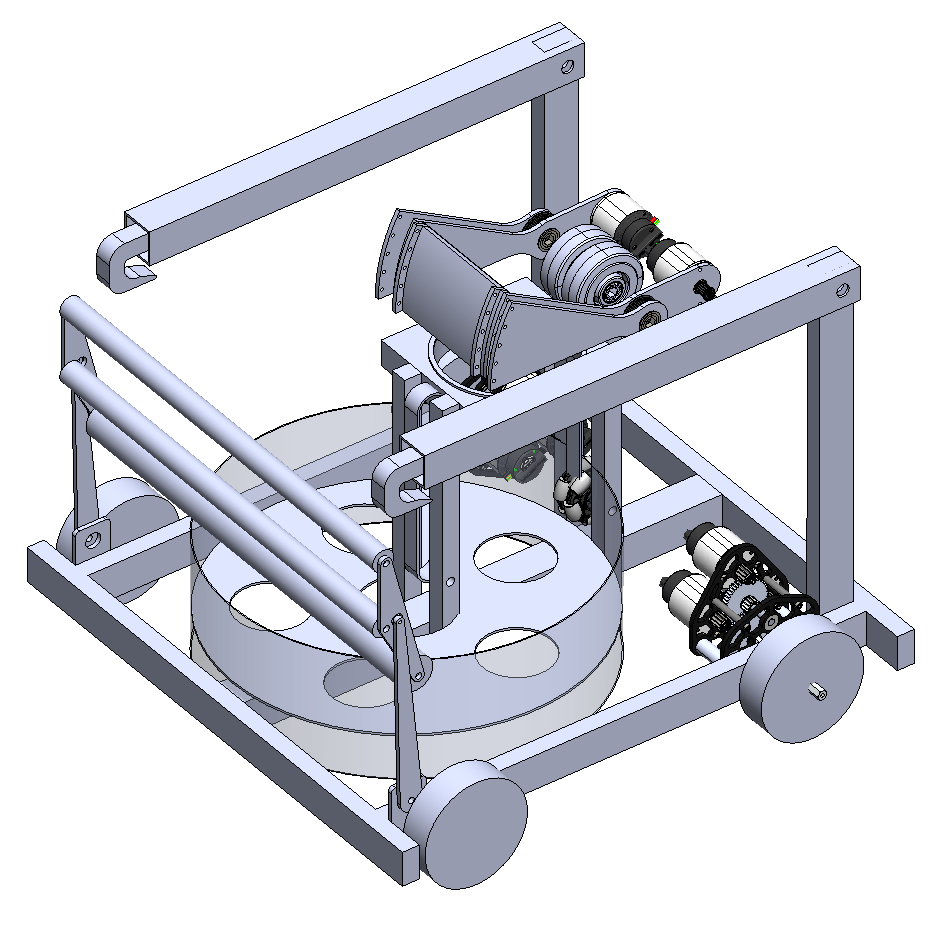
One notable event in our team training was our recent participation in Chezy CAD, the CAD competition hosted by FRC team 254. Fortunately, we had enough people interested in participating that we were able to fill two teams up and design two unique robots over the 2-day event. The challenge was to design a mechanism to climb up a vertical pole. Overall, it was a great learning experience for everyone involved and hopefully we can get even more people to join in next time.

Our first team’s robot.
Our second team’s robot.

But, while new members have been training diligently (and hopefully learning a lot :)), we’ve had some of our older members working on improving Torpedo and making it as good as it can get. When looking back at this year’s matches, our shooting stands out as sloppy. We simply were not able to consistently get shots into the port. The biggest source of the problem becomes a little bit clearer once you look at exactly where the balls go. In an average shot of five balls from the trench, we would often have balls undershoot, overshoot, and fall right in the middle of the port. This occurred even when the tube angle and drivetrain position stayed perfectly motionless throughout the shot. So, there was a clear problem with output velocity. Under closer examination, we were not running our shooter wheels through a PID control loop and they were easily varied by things like battery charge and general inconsistency. So, we set out to implement PID on those wheels.

However, when implemented, the maximum output speed lowers and Torpedo can no longer shoot from the trench. After some more examination, we found the ratio on the shooter wheels to be 2:1 (ie: the wheels were running at half the speed of the motors). So, we switched out the ratio of the wheels to a 1:1 in order to allow our software to implement PID control and ensure a consistent output velocity.

Upon a second glance, this actually improves our shooting in a couple other ways. To start, increasing the speed of the wheels makes it so that the variance within input speeds into the wheels (via the belt) doesn’t have as big an impact since the increase in speed through the wheels will be considerably larger than the variance in tube velocities (which heavily rely on loose friction). Additionally, having a faster output speed makes our shot a bit straighter, which will allow us (with proper tuning) to have a lot more accurate shots that hopefully consistently reach the inner port.

Here you can see the robot shooting from the trench with the new 1:1 ratio on the wheels. PID is not yet implemented in this video.

As you can see, even with PID not implemented (it was done right after shooting that video), we have some more consistent shots that go roughly to the same spot. This will hopefully only get more accurate. Finally, the main problem we are now having is that balls consistently bounce out after being shot in. Once we get some really accurate shooting going with PID, we’ll be able to aim our balls so as to hit the angled piece of the port and go directly down (or go for the inner port).

We will continue improving the shooting and start to adjust and tune our limelight adjustment over the next three weeks so as to hopefully have an almost fully autonomous shooting sequence by the time we get to winter break.

As we prepare for the 2021 season, we have also been working on a design for the 2021 robot. This new design is almost a complete architectural rebuild of Torpedo, but addresses all of the key issues and fundamental flaws in the overarching design of Torpedo that were mentioned here.

Most notably, the intake has had a great deal of progress and has taken some shape and form. Some immense design challenges were associated with it that were elegantly addressed and we will soon have a wonderful machine that should shoot balls into our robot faster that we shoot them out (that’s just some imagery I’m obviously joking).

The intake as of now.

Additionally, a thorough design review was performed on the climber and drivetrain and some key areas for improvement were noted. In order to reduce part count and improve manufacturability of the climber, some areas where bearings and complicated parts were used were swapped for Ultra High Molecular Weight Polyethylene and aluminum plates, which makes our elevator a lot easier to build and maintain. Most of these changes are internal and not visible on the outside.

The new climber design with a paint job for fun.

I have to, of course, mention the crazy coloring. In part this was just playing around in the program, but it was also a vision for the future. Many teams color their robots and with potentially some time saved on the design process, we might be able to spare a couple extra days to get our parts powder coated by a potential sponsor if we decide to build this robot. This is something that we need to thoroughly research and plan if we decide to do it, but for now, it’s just some eye candy.

Finally, the final new development in our robot design process was the testing of our shooter prototype. We hooked up the two motors on the hooded shooter to the intake wires on our 2019 robot (Flipper) and tested various shots on the field, noting the hood angle successful at each position.

Shooting several balls from our prototype from the trench.

As you can see, this is wildly inconsistent. There are many variables that cause this, including variance in input speed (placing the balls into the shooter), slightly tilts in the holding of the prototype, a flimsy architecture janky structure, inconsistent rpm on the wheels, and plenty more. But, after averaging out our results from several tests, we were able to find a rough range of values that give us a range of hood positions and angles for our design. We will continue to test different variations on compression, speed, angle, and hopefully even test a rocker wheel at the top for precise backspin. A future prototype will also hopefully be attached to a “tower” prototype that provides consistent feed rates and more accurate results.

As we go on into the final stretch of 2020, we will continue to train new members and get everyone ready for the season, improve Torpedo until we cannot anymore, and diligently prepare the robot design and entire team for the 2021 season and all the exciting adventures that are sure to come with it. Lots of planning to do, work to come, and fun to have ahead. And now, I leave you with Torpedo just chilling in his room.

Taking a break after some good shooting.

✌️

Torpedo

Team 2658’s 2020 robot “Torpedo” was incredible. It is arguably the best robot the team has ever created, won the Quality Award, and placed 5th/58 at the Del Mar Regional. It can also be so much better. So, let’s take a look at it.

Conception

Let’s begin with with how we came up with the idea for Torpedo. In our initial analysis of the game, our main priorities for robot capabilities were as follows:

  • Auto
    • Move away from initiation line*
    • Detect bottom port and place balls in*
    • Detect power port and shoot balls in
    • Detect inner port and shoot balls in
    • Pick up more balls
  • Teleoperated
    • Store 5 balls*
    • Dump 5 balls at once*
    • Intake from the floor*
    • Intake from the bottom bay*
    • Place balls in the bottom port*
    • Shoot balls into the power port
    • Shoot balls into the inner port
    • Be able to autonomously gain Rotation Control
    • Be able to autonomously gain Position Control
    • Intake from the top bay
  • Endgame
    • Be able to climb*
    • Be able to climb on high end*
    • Be able to climb in the middle*
    • Be able to climb and adjust
    • Be able to climb, adjust, and pick up one robot
    • Be able to climb, adjust, and pick up two robots
  • Defense
    • Blocking area

The higher up on each sub-list, the more important we thought that ability was for our robot. Items with an asterisks were marked as necessary to the functionality of the robot and things we would implement for certain. Items with a strikethrough were not to be considered.

If we dig deeper into the reasoning, we can see that being able to shoot low and climb were our most basic criteria, while shooting into top ports and more adjustability with the climb were less important. However, with several reach goals slowly making their way into our “needed” goals pile, we set out to develop an architecture for a robot that could shoot into the low and top port (with software expansion into the inner port) as well as climb.

Profiles:

Three profiles were presented to be considered for execution. All the profiles were short enough to traverse under the control panel (color wheel). Two of the profiles had an elevator flip up and grab onto the bar as a climb. The other had a double reverse four bar linkage system for the climb. Two of the profiles had single flywheel hooded shooters (not on turrets) that were low enough to be able to shoot into the low port. The other a shooter with to flywheels on each side. The two profiles with hooded shooters had a rigid tube system to hold five balls and bring them to the shooter. The other had a pivoting tube to adjust the exit angle of the balls. All the intakes were a relatively similar over-roller design.

In the end, the profile which was chosen had an elevator flip up for the climb and a tube move up and down to adjust the exit angle of balls shot out of a side-wheel shooter.

Execution

While the process of designing, building, wiring, and coding this robot merits itself much analysis, I want to focus more on the robot itself in this blog. Therefore, all you need to know is that the robot was designed, built, wired, and coded. What follows will be an analysis of – after the completion of the robot – the successes and failures of its execution of the desired elements of gameplay.

Mechanical Quality:

The design of Torpedo was definitely the most complex we’ve had to build. That being said, the minute details were done so in a way so as to ensure long-lasting effectiveness. Most mechanisms, due to good design planning and consideration and an increased attention to high tolerances and accuracies in build parts, had few if any failures. There are two notable exceptions to this, however.

The climber had several issues with friction ,associated with the screws driving the elevator, that led to initial climbing problems. This issue was mostly fixed by drilling out the bushings holding the screws in place to allow for more wiggle room. Additionally, the flimsy nature of the shaft coupler on our tube adjustment mechanisms meant that we saw frequent shattering and a need for replacement. This issue was largely addressed by replacing the “springy” shaft collar with a rigid one. A “dead spot” in the handoff between the intake and tube caused some problems with jamming and therefore led to slow intaking. However, after much testing and altering, a solution was finally implemented that achieved the smooth transfer between the two mechanisms. Overall, however, an attention to detail, accuracy, and assembly in both the design and build process led to a robot which deserves the quality award.

Controls Quality:

Torpedo continued to demonstrate its superior quality in our electrical system which, as opposed to the connection and issue riddled 2019 Season, had almost no issues and acted exactly as intended. Torpedo’s software was also able to implement some long-overdue features such as using sensors to adjust and limit movement. We also had a very consistent and reliable autonomous routine. But, a plethora of issues in our pneumatics system and shooting capabilities largely overshadow these successes.

As soon as the robot started running we began encountering pneumatic problems with our compressor and various connections coming loose. Because of its inaccessibility, the system was difficult to fix properly. Through weeks of testing and debugging, the sources were finally pinpointed to some faulty components and badly implemented connections. As soon as these core issues were addressed, the pneumatic system worked as flawlessly as the electrical.

With our software, the main issues lie within the precision of the various functions that were being executed. For example, our shooter shot out balls, we could set angle positions at various locations, and we had an effective driver/operator controller system. However, they were not consistent or precise enough. Our shooter wheels could not maintain a constant rpm and, thus, exit velocity of balls varied drastically. Additionally, the various angles we had set for the tube were off by a small amount each time, resulting in more error. The shooting this year was based around set positions for the tube angle, but this meant the robot would have to be virtually in the same spot each time, and that greatly varied.

These problems will be addressed with better PID implementation and an increased attention to detail. Additionally, some achievable reach goals were not reached. For example, side to side alignment using vision tracking from limelight never fully worked and we therefore heavily relied on driver and operator adjustment for shooting accurately. Further development of autonomous would also have been on the list of things to nail. Many of these issues can and will be resolved with time, but they were consistently one of the greatest failures of this robot.

Drive Team and Strategy

At the end, in terms of execution, it comes down to what drive team will do with the robot. In many ways, drive team was very effective this year. For example, Neel (our driver) was able to adjust with a good amount of accuracy side-to-side for shots from the trench entirely without any assistance. Alli (our coach) was very effective in negotiating and determining effective strategies for our games and executing on those strategies. Some seemingly drive team issues (such as shooting alignment) are, as previously discussed, largely due to other factors. But, similarly to the software, a lot of the performance issues came from drive team.

One particularly frustrating setback was the climbing consistency. In 2019, we had a considerably less reliable climbing mechanism yet were able to climb almost every single match. This year, with a near flawless climb mechanism at the time of competition, we struggled to climb even half the time. A clearer driver-operator communication was necessary as well as a concrete, pre-determined plan for which hooks (top or bottom) would be used. Additionally, many issues were encountered with properly lining up to walls (ie: setting up to shoot up against the port or going back to the human player station) and with traversing underneath the color wheel. While this is definitely a product of a long and difficult-to-control drivetrain, more practice and experience could have brought much better results. Relating to strategy, there were certainly in-game moments that could have benefited from different directions. Things like choosing to shoot from the auto line instead of the trench or communicating with other teams for two robots to climb could have changed the course of some crucial matches. And, finally, timing for intaking balls from the human player station was, most of the time, not perfect. This, paired with human player station misalignment on the robot’s part, led to often times slow intaking times.

Most of these problems can and would be solved with simply more time spent practicing with the actual robot and configurations. Our entire drive team was great with the Deep Space but, since there wasn’t an extensive amount of practice with Infinite Recharge, the results were not the same. Additionally, practicing on as full and realistic field as possible, especially for this game, is crucial to drive team success.

Fundamental Issues

All of the successes and issues mentioned focus on the improvement – or lack thereof – of Torpedo. However, when looking back at the season and matches, some key fundamental issues with the robot architecture arise.

Drivetrain Size

As mentioned during the drive team section, the long nature of the drivetrain turned out to be a major issue. Designed so the elevator could be longer, it made slight adjustments in robot trajectory difficult to execute and therefore overall made the robot harder to control and move.

Intaking Balls

Torpedo’s intaking of balls was not as fast as it could have largely due to the tube restrictions. Because only one ball could fit inside the tube, only one ball could be “sucked in” by the intake at a time. This meant that when approaching balls the driver and operator had to make sure only one at a time was touched. This considerably increased the time spent while also requiring a greater amount of precision in driving. Our ability to only get balls from the bottom human player port also proved to be a hurtle. Many other teams were able to get two balls at a time from the top human player ports while we were only able to get one at a time from the bottom.

Shooting Capabilities

Torpedo relied on side-to-side shooter adjustment using the drivetrain. This, in general, is ineffective because of the inaccuracy and heavy reliance on friction with the carpet. The problems with this were further amplified by the aforementioned drivetrain issues. Up-and-down adjustment was done by moving virtually half the robot up and down a lot. This meant in some cases that adjusting for the up-against angle would take 2-3 seconds and that, because we were moving such a large mass, it was more prone to failure.

Center of Gravity

This is a much more minor problem, but the center of gravity of Torpedo was shifted as much as possible towards the back of the robot. This meant that, when quickly attempting to accelerate from rest or stopping quickly, the robot would lurch and jerk forward or backwards. This was potentially dangerous (for the robot) at times as it lurched and jerked into the bottom of the color panel while passing underneath.

Conclusion

In the end, there are thousands of other small things that can be looked at on this robot, but this covers what are, in my opinion, the essential strengths and weaknesses. An effective future robot to play Infinite Recharge would be able to keep the strengths and fix the few problems we had through a combination of physical and software solutions.

If there is one thing, however, that I would take away from this robot it is that of details. We were super effective (and won an award for it) with our design and build because of the attention to the small details. To a large extent we had a great structure and implementation in the other teams as well, but the details, the miniscule specifics is where we lacked. So, as we continue to build more robots and evolve our understanding of robotics, keep in mind the details and making sure every little tiny aspect of the robot is as perfect as we can make it. Then we can be the team I know we can be.

And, finally, I wanted to just say that the robot is the robot and the team is the team. No individual is responsible for the successes of the robot and no individual is responsible for the failures of the robot. So, as we forge on and continue to strive for better and better, keep in mind that we forge on together as one. E pluribus unum.

✌️

The Blog is Back

I know what everyone’s thinking. “Oh my Toshko why did you wait so long to bring back the blog I had no idea what to do during quarantine without your blog and thank you so much for bringing it back because now my world is complete.” I know I know. Don’t worry, it’s back.

All jokes aside, now that we’re starting to do some more things – both virtually and in-person – I wanted to bring back the blog so we can highlight, record, and learn from what we’re doing.

Summer Recap

Over the summer, things were more stagnant than usual, but that did not stop us from still accomplishing some things. Most notably, a couple design team members participated in two CAD-a-thons, each lasting one week. During that time frame we got some good practice with designing a full robot and all the intricacies of each mechanism.

Our first CAD-a-thon robot.
Our second CAD-a-thon robot. The technical binder for this robot.

Our marketing team also got started during the summer on some grants and sponsorship ideas. So far several promising grants have been submitted and we await a response from them. We have also received several grants from some companies, which has given us a much-appreciated boost.

Post-Summer and Off-Season

Now that the school year has started, we’ve also begun working on several projects and developing skills. The largest of these is probably the current design for our 2021 season robot. Although FIRST has said there will likely be no in-person competition next year, there will still be many opportunities to develop a new robot for possible in-person competitions and virtual submission. So, in preparation for an even better season than this one, we decided to use the knowledge that Infinite Recharge will be replayed to start designing an even better robot for 2021.

Torpedo (our 2020 robot) was great robot. Arguably the best the team has made. However, with the goal to always be the best robot on the field, there were several improvements to be made. So, several profiles were conjured to find the optimal way to address critical hardware problems.

John’s Profile

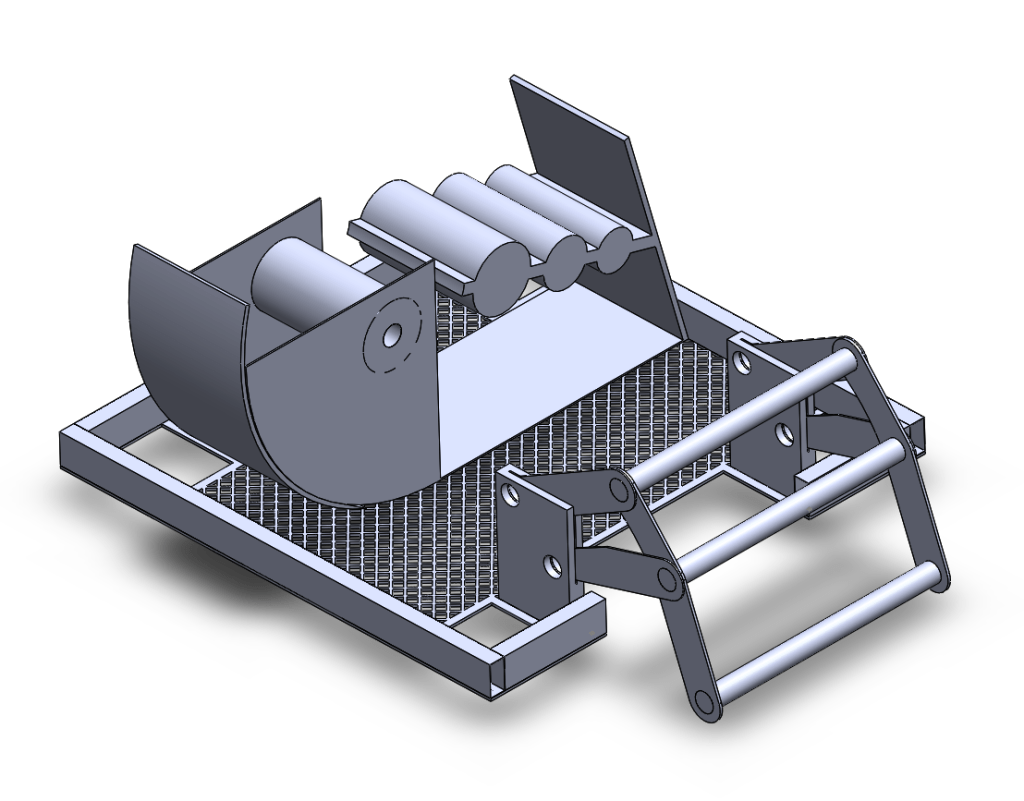
While a little scarce on detail, John’s profile provides a preview of an extremely agile robot which could be very effective in competition. A swerve drive base provides quick movement and easy side-to-side alignment for shooting more accurately. Additionally, a continuously adjustable hood would provide for easy angle adjustability for shots. No climb was CAD-ed but the profile planned to have a climb mechanism as well.

John’s profile

Keshav’s Profile

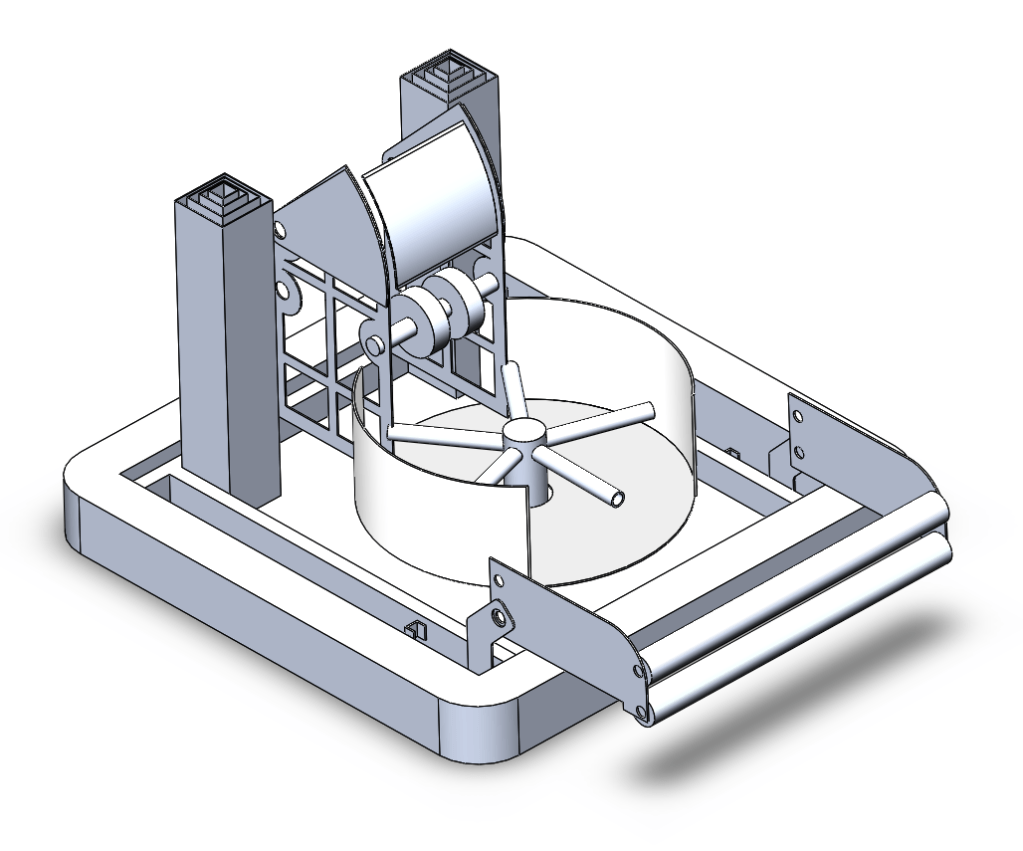
Keshav designed his profile to address many of the problems he saw with Torpedo. It allows for an easier ball intake by having a serializer (the circle in the middle) accept multiple balls at one time and sort them into a neat line. Then, they are – one by one – brought up to the shooter where an adjustable hood adjusts the angle of release of the ball. The side to side motion, in Keshav’s profile, of shooting adjustment would be handled by the drivetrain. For a climb, the profile presents two telescoping arms that extend all the way and lift the robot a considerable amount.

Keshav’s profile

Toshko’s Profile

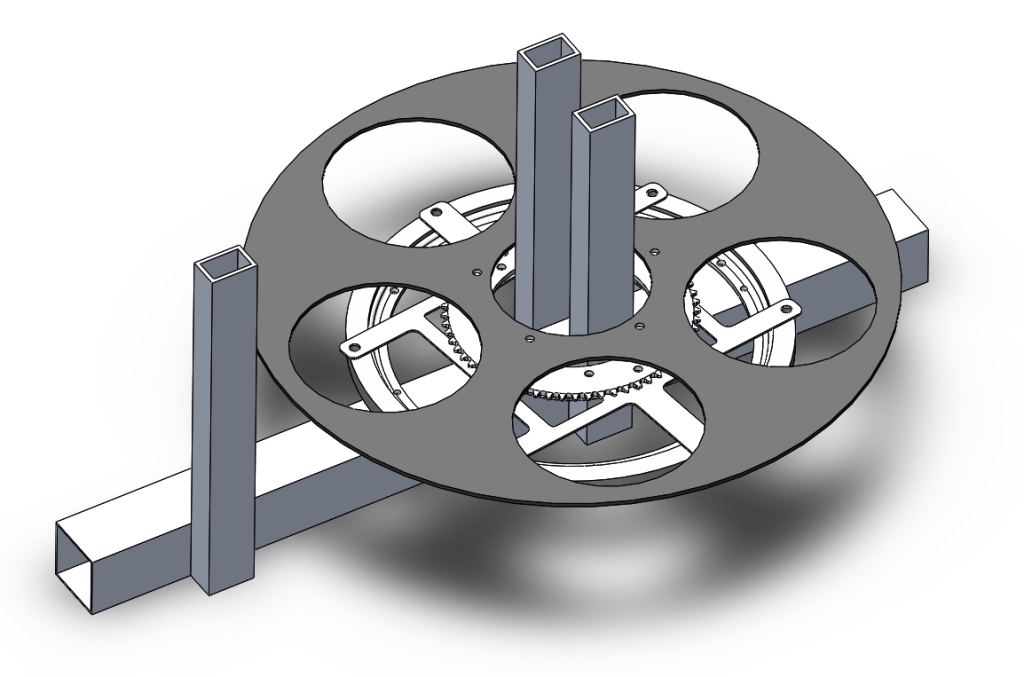
My (Toshko) profile captured similar characteristics and solutions to problems as Keshav’s with a few distinct tweaks. Most notably, my shooter has a turret controlling the side to side motion of shooter adjustment rather than rely on the drivetrain. Additionally, my climb closely resembles our flip-up elevator climb on Torpedo but, instead of an elevator, two telescoping arms would flip up and grab onto the bar. Finally, one small detail is that instead of dividers separating the balls in the serializer, my profile uses holes cut in a bottom panel to allow balls to settle down.

Toshko’s profile

In the end, my profile was chosen by the design team to further develop and design. Tasks were divided the design process started. So far, the drivetrain, most of the climb, and initial sketches of the intake have been completed.

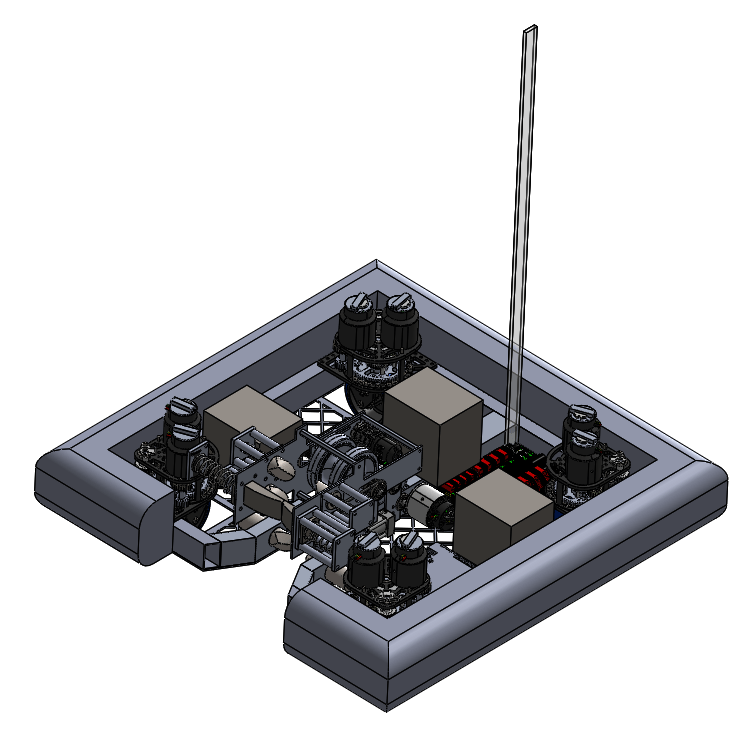
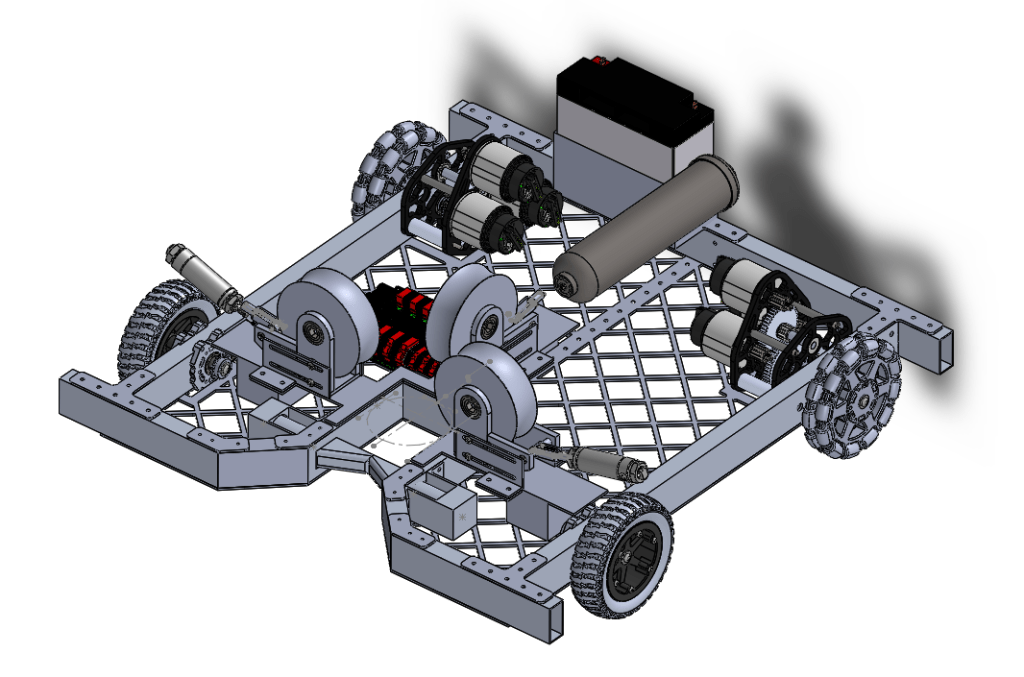
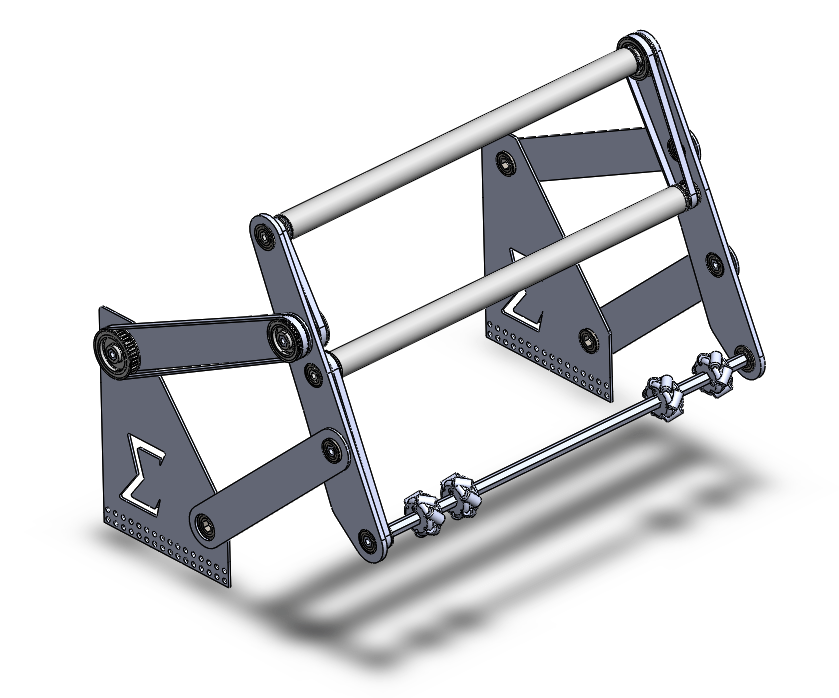
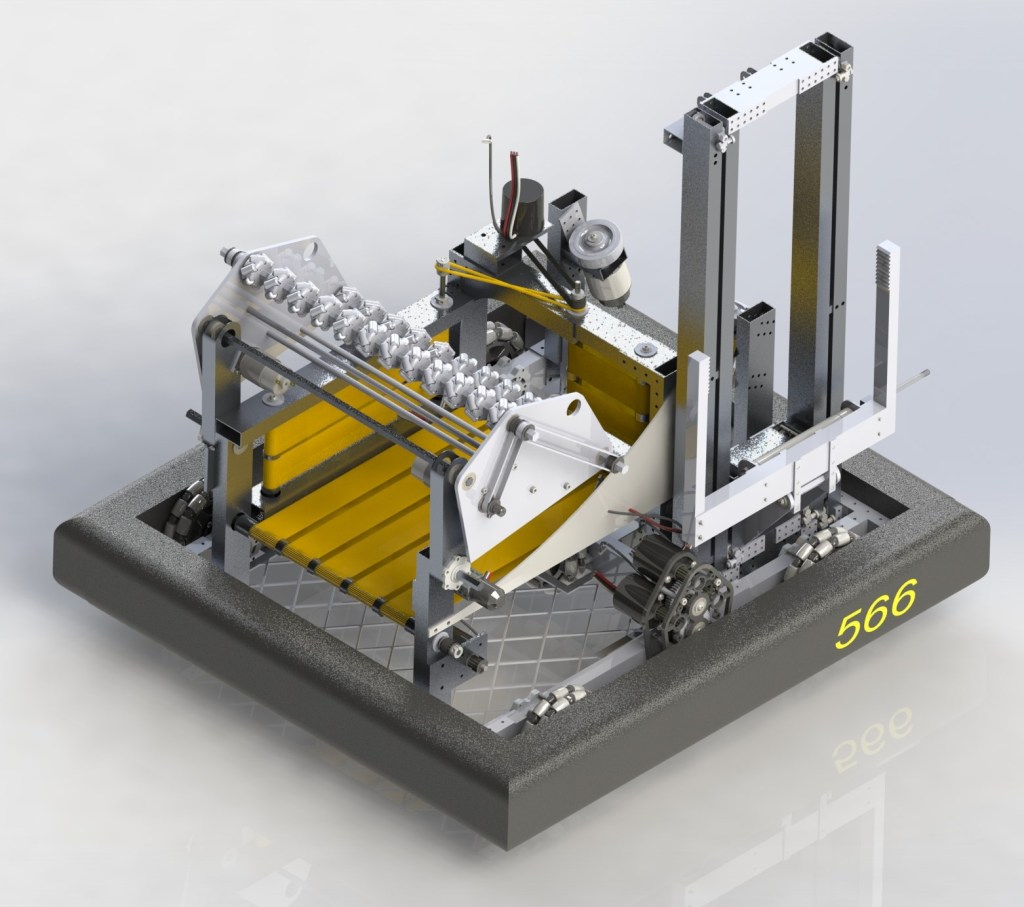
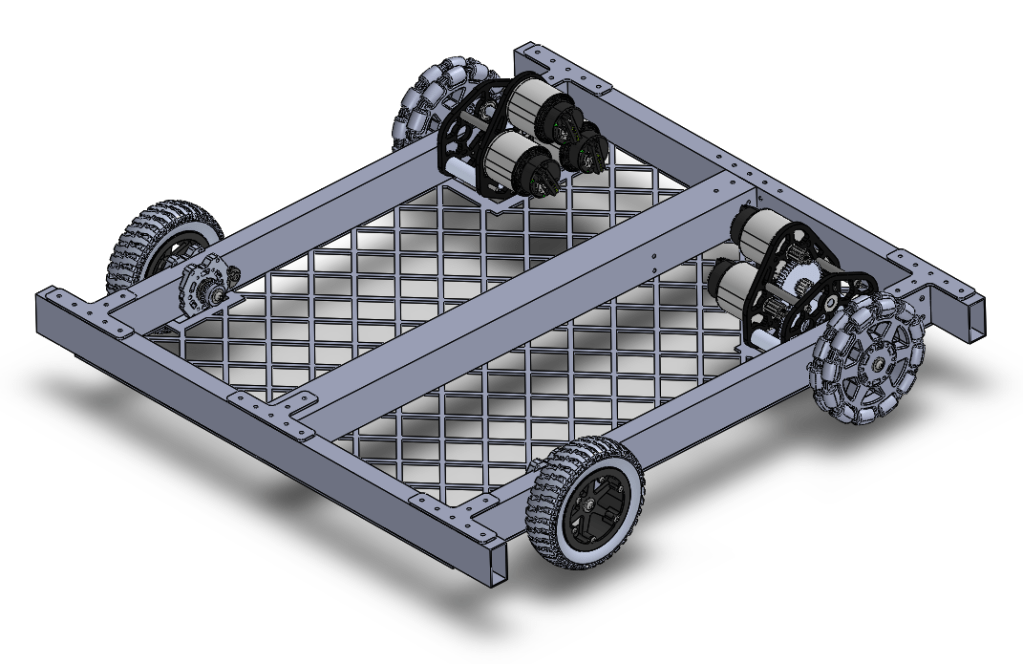
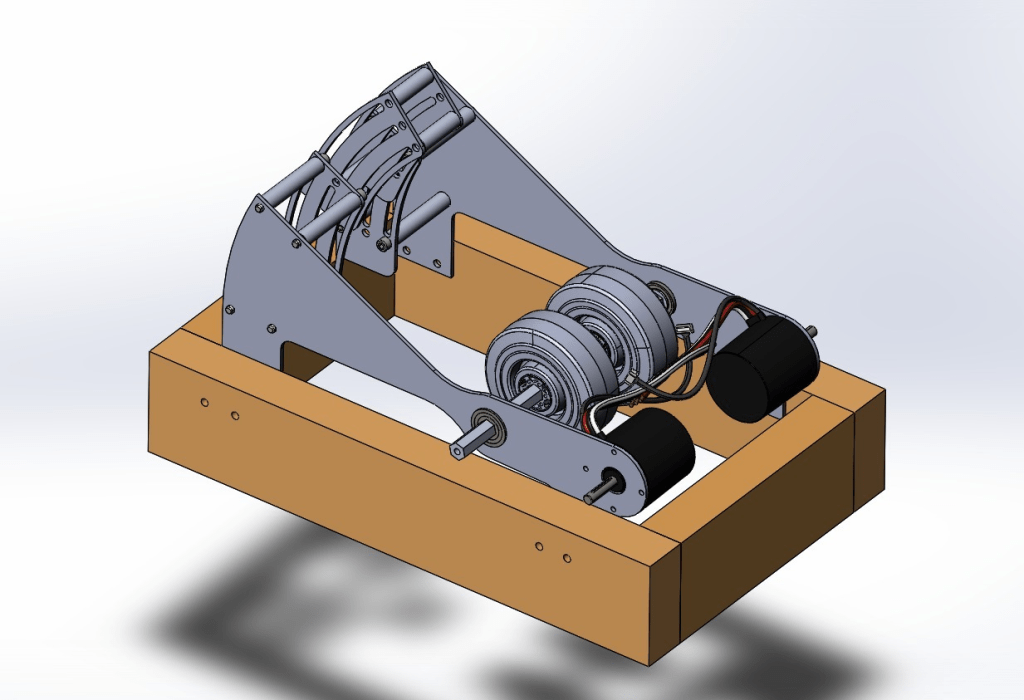
The drivetrain improves upon Torpedo’s due to it’s much shorter nature. It closely resembles that of our 2019 robot “Flipper” in size and functionality. The same wheels, gearboxes, and general architecture that we’ve used for the past two years are implemented again. A beam down the middle provides a structural base onto which the shooter tube and serializer (or spindexer if you may) can easily mount. The position of the wheels as you see them in the screenshot may change as we decide which position would be more suitable for the omni wheels.

The drivetrain (in CAD) for our 2021 robot (chain not CAD-ed)

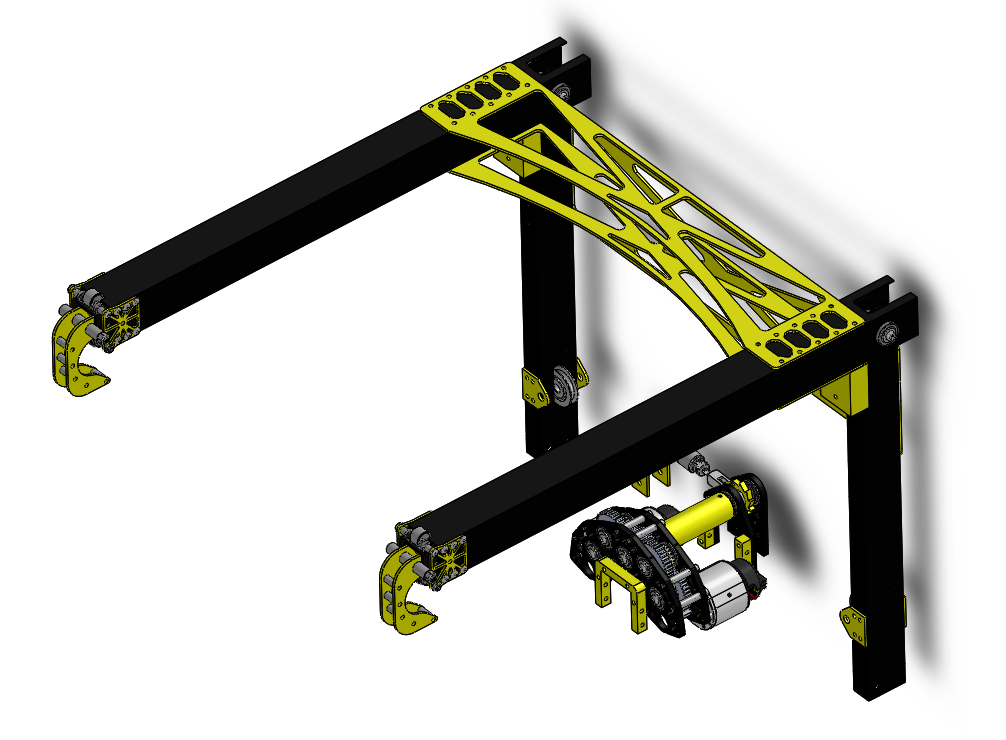
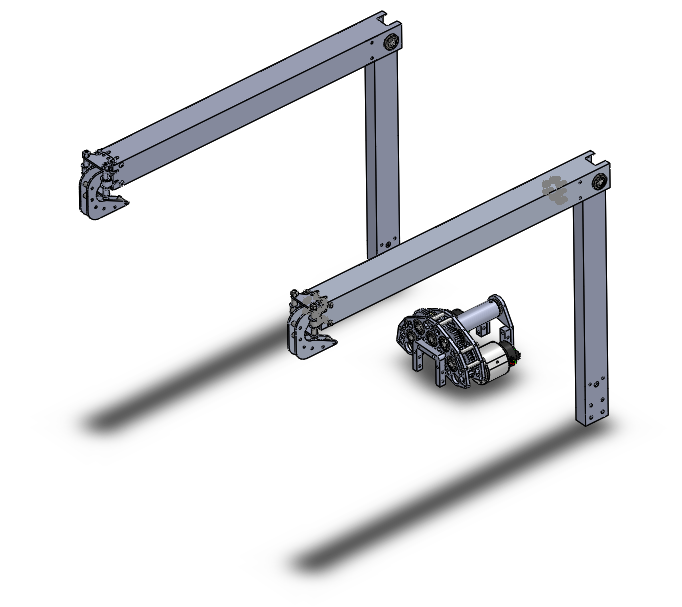
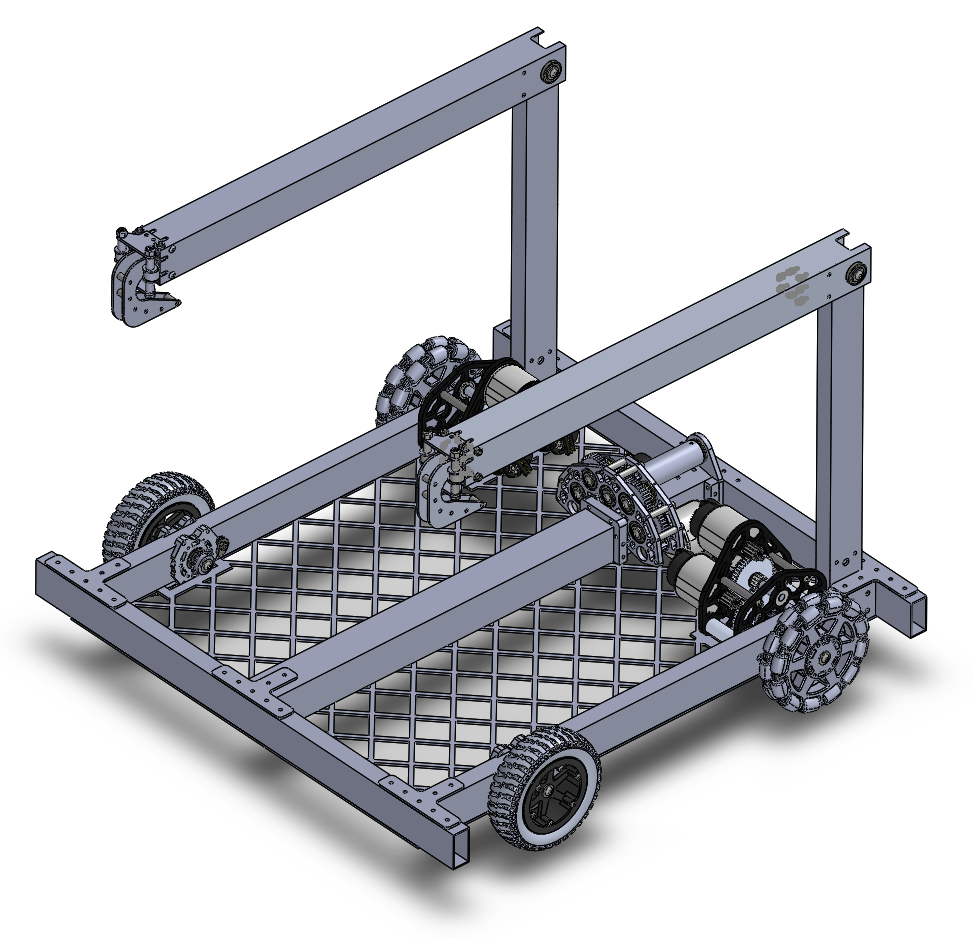
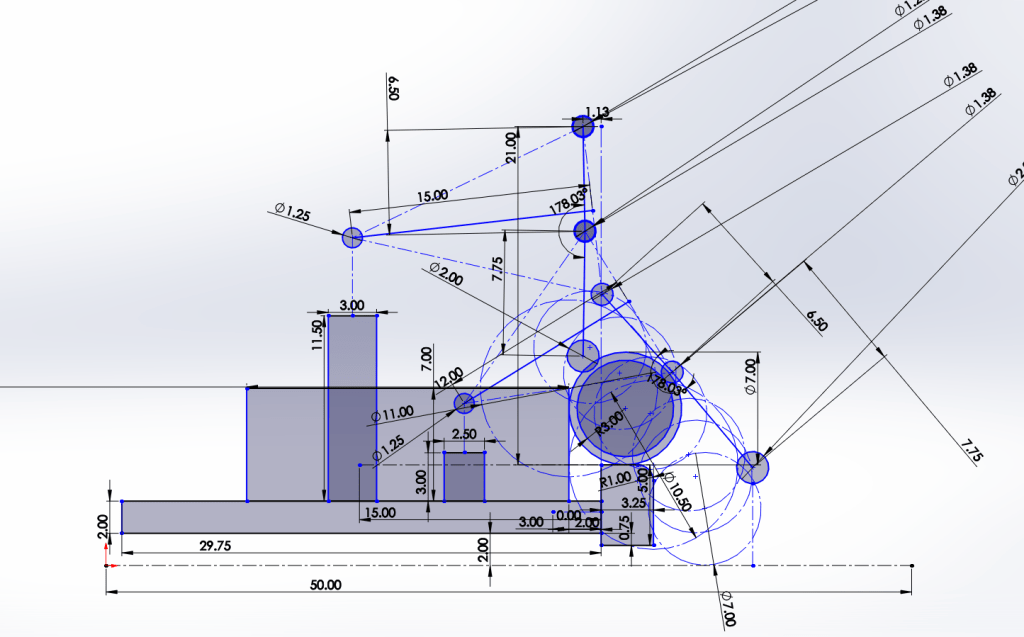
The each side of the climber has a telescoping arm with one inner stage and one outer stage. The outer stage pivots on an elevated beam at the back of the robot after which the inner stage extends upward to grab onto the bar. Two constant force springs extend the inner stage upwards while a rope attached to the bottom of the inner stage travels down to the base of the drivetrain and spools on a winch. Once the robot is hooked onto the bar, a two motor winch should provide a 1 second climb. Several small details – such as a ratchet, diagonal supports, and a few minor tweaks – still need to be CAD-ed. For those interested, these are the calculations for the climber and its sub-mechanisms. They have not been peer-reviewed yet so if you find a flaw, feel free to point it out.

Initial geometry sketches for the intake are also almost done. These are important to create in order to properly design an intake that we know will control the ball and guide it into the robot the way we want it to. Additionally, they provide a sound framework for the CAD of parts so that each part is based on the ball path and not simply on dimensions.

The intake geometry sketch as of now

The final element of the robot design that is in progress at the moment is our shooter. However, in order to create an effective shooter, we first wanted to create a prototype that will hopefully give us a range of angle values for our hood.

The CAD model of our shooter prototype

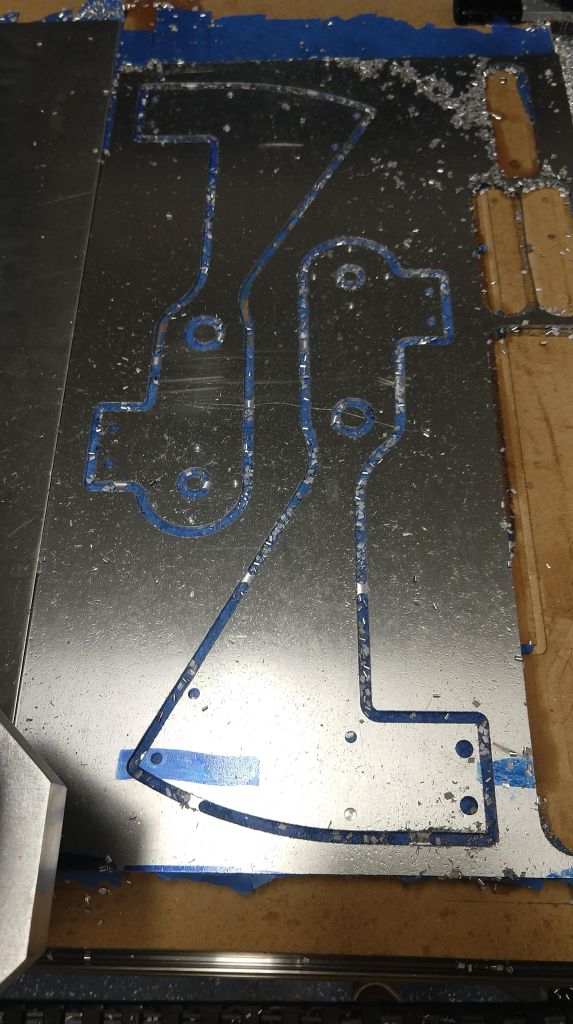
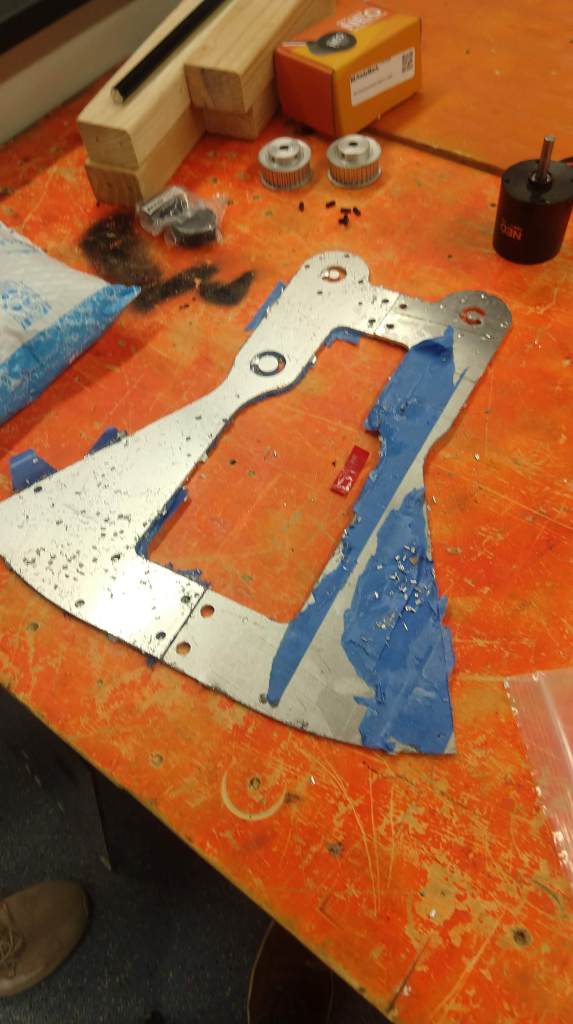
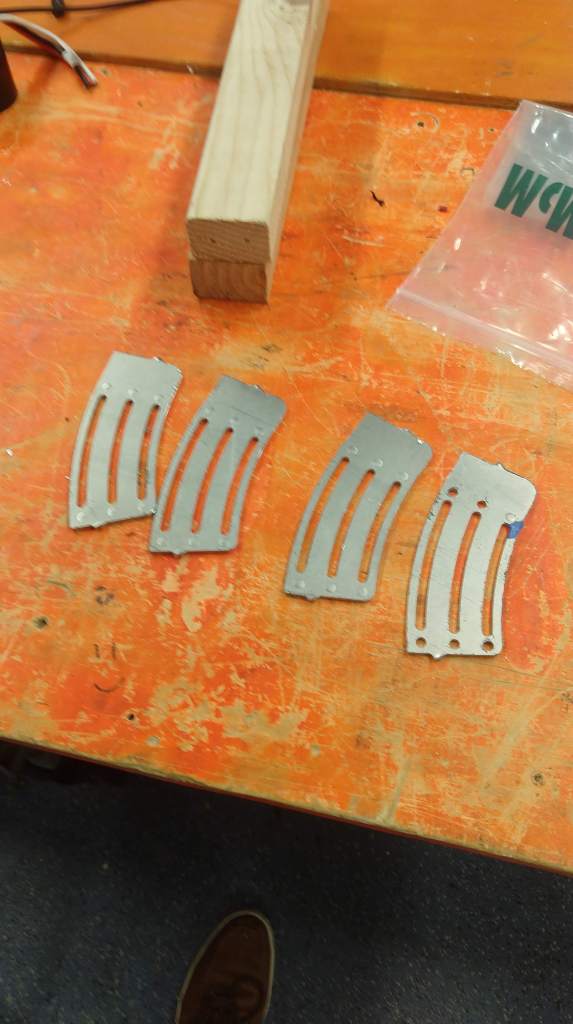
So, as we had our second in-person meeting on Thursday, we fired up the CNC and managed to churn out some nice plates to be used for our prototype. These were all made out of 1/8″ spare aluminum sheets. We will use two Neos to simulate the power of two falcons on our shooter. Two 4″ colson wheels will be used with about 1.5″ compression on the ball for initial testing. However, many wheels will be tested to find the best option.

The next time we meet, the shooter prototype will be assembled and hopefully tested. Since we do not have an extra PDP or RoboRIO, we will use Flipper’s electronics board and the wiring for its intake motors to run the two Neos on the prototype.

Finally, we also are seeking to vastly improve the software of Torpedo. Key issues deal with the PID on our tube adjustment and shooter wheels. Particularly, we hope to reach a consistent rpm on our shooter wheels in order to maximum consistency in shots. This, paired with a lot more limelight development, should allow us to fix the wide array of shooting problems we had at competition.

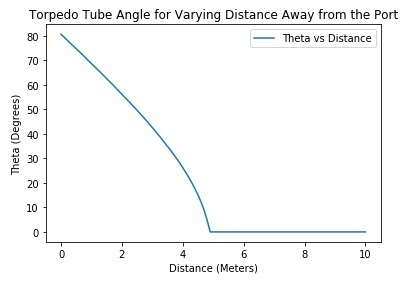
On the topic of limelight development, I wanted to give a brief overview of an interesting problem we recently solved. A reach goal of ours since the season has been to enhance our limelight capabilities such that our robot can, at any point on the field, adjust to the right tube angle and shoot the balls into the port. However, the difficulty of the implementation of this idea on our robot comes with the fact that, as our robot changes its release angle, it also changes the distance and height of the release point. Therefore, when trying to solve the projectile motion physics problem, we are left with an unsolvable equation. In order to solve this, a small program was written to, for each theta value for the tube angle, compute the value of the left side of the equation and the right side of the equation and find the theta value at which the difference between those is smallest. This process is repeated for each possible distance. The physics calculations for the situation can be found here. When completed, the graph of the various distances and the various corresponding theta values looks like this:

At one point, the velocity is not high enough for the ball to go into the port and so we get a 0 value since it’s impossible. This graph is not necessarily correct as the constants (velocity and various field and robot measurements) are heavily approximated, but it gives a general idea of what continuous, limelight-based tube adjustment would look like. This should hopefully serve as a useful tool to implement once we improve our limelight recognition and ensure shooting consistency.

So, that about wraps up almost everything that’s been done and being done so far. I hope to write another detailed blog analyzing Torpedo’s successes and flaws soon. And, finally, since I know you’ve probably been wondering how Torpedo’s been doing, I leave you with this video:

The robot working for the first time after eight months

Just to calm everybody’s nerves, the climber in the video didn’t work because one motor wasn’t engaging with the screw. It was a simple problem of a loose coupler and, when the coupler was tightened, the robot climbed effortlessly. Additionally, the intaking in that video is smoooooooooooooooooooooth (much smoother than at competition).

That’s all for now folks. Hopefully more to come later. Peace out. ✌️
The End of Infinite Recharge

On Thursday morning, as we were getting ready to head to the San Diego Regional, we received the news that the regional would be postponed. Within a couple hours we received further news that the entire FRC season is suspended and that both world championships are cancelled. You can read the full announcement here.

As of now, the future is still unclear. We do not know whether the San Diego Regional will still occur and if it does, at what point in time. All we can say for certain is that for at least a couple of months, we will not have any competitions.

However, we must not despair. There is still much we can do to both improve our robot (for possible legitimate and off-season competitions in the summer or fall) and our community. Right now we must also focus on preparing for the next season as we lose crucial seniors and so that we can make an even better robot next year.

We should all be thankful that we at least got to compete (many teams have not had any competitions) and that we performed very well in competition as a robot and as a team. More info is soon to come (along with a season recap and detailed lessons for next year) as soon as it is available. For now, take a little bit of a break and we’ll resume robotics with more passion and fun than ever before.

Post – Del Mar Regional

These last two days (and whatever time we have left tomorrow) we’ve really focused on ironing out the little kinks we have to get right for this next regional. Most of it comes down to our shooting and the software that goes behind it. So far, we’ve been able to change to PID on our shooter wheels, which will stay at a constant speed to avoid variability in various balls. We’ve also added PID on our position macros for the tube. This will let the tube position more accurately, which should provide us with much more accurate shooting. This should all add up to us being able to have a consistent speed on the shooter wheels that is independent of battery voltage and also have a consistently accurate macro for the various shooting positions on the field.

Software has also worked a bit (and will hopefully finish tuning tomorrow) on our limelight drivetrain adjustment. It still swings a bit around the center of the target but it is more like a jitter right now than a swinging. The way it is now will greatly help the driver but software should be able to finish testing tomorrow and both get the shooting macros perfectly calibrated and get our limelight alignment to work.

If all goes well and we have time, a timer-based (yes we know it’s the worst way to do autonomous but right now we don’t have a lot of other options) 6-ball auto will be tested and, if it’s close to completion, perfected.

As long as these adjustments work at the competition the same way they have worked on our field, we should be able to spend all of Thursday practicing. As long as our cycle times get slightly faster (or even stay the same) and we are able to actually make the shots we shoot, we should be able to rank close to first or even first at this next competition. If we play our cards right and hope for a bit of luck, this could be our ticket to worlds.

Del Mar Regional

Friday – March 6

On Friday we were planning on quickly getting inspected, tuning our limelight on the field, and driving all day long in practice matches. As we would normally expect of any robotics team, the plan quickly flew out the window. We spent some time initially drilling out the bushings on the other side of the climber in order to make sure that there was minimal friction and that it would run smoothly.

At the same time, electrical was able to fix the issue with the compressor not shutting off when it reached full pressure. However, we continuously met pneumatic leak problems and most of the day was spent trying to fix them. We went to the field for limelight calibration but had to cut that short in order to get back to our pit for inspection. We were inspected in a timely manner but were not able to return on time to the field for calibration. As a result of us not having a cable for our network switch, we were not able to access our limelight feed outside the field and, therefore, not able to tune and work on its calibration despite getting threshold values from another team. Nevertheless, we were able to – in between our fixing of the pneumatic issues – play 4 practice matches during the day. We climbed in two of those matches. Every time we attempted to climb, we climbed successfully. We were able to learn ways to play the game and also get adjusted to playing on an actual field.

Saturday – March 7

Qualification matches started and from the second we saw them, we knew our hardest ones were towards the end. At first, we had some intake problems and some climbing timing issues, but we were overall able to score decently and climb relatively quickly and reliably. However, things started to slowly go downhill. Our macros for shooting seemed to slowly drift upwards during the day and – as a result – our accuracy decreased significantly as we missed more and more balls. Nevertheless, we finished our second to last match on Friday ranked number 1. Our final match on Friday (our match against 3255 SuperNURDS who would go on to win the regional) we knew from the beginning would be hard. But, due to our inconsistent shooting and some stubborn alliance partners during the endgame period, we were neither able to score balls well nor able to get a double climb. As a result, we ended up losing the match and significantly dropping in ranking.

Sunday – March 8

With some valuable lessons in mind from Saturday, we were able to tune our macros a bit and improve the shooting accuracy by a considerable amount. Our first match on Sunday was the most balls we’ve put in a match. At this point in time, we had also gotten to the point where our ball intaking speed was vastly improved from the start of the regional. We quickly won our first two matches but, as with the match against SuperNURDS, we knew our last one would be the hardest. We faced off against 294 (who ended up being the first seeded team) and nearly edged out over them. Due to a control error and our controls to the drivetrain cutting out in the last second, we were unable to climb and therefore lost the match.

Nevertheless, we were ranked 5th and after talking to some other teams decided we would want to be in an alliance with 4698 Raider Robotics and 6695 Alpha Knights. After alliance selections we got together to discuss our strategy for the playoffs. Everything seemed sound and things looked like they were headed in the right direction. However, as soon as the match started, our shooting accuracy decided to just abandon us. Paired with excellent defense from the opposing alliance and some inconsistency and lack of speed on our part, we were not only able to score a lot less balls but also failed to climb due to a misalignment error. The second match was much improved (since we decided to shoot up against the wall and not rely on trench shots) but, due to the opposing alliance’s triple climb and our lack of one, they edged out and took the win.

It is important to note that in our last thirty seconds of the second quarterfinal match, our lead screw for the tube adjustment mechanism snapped. So, even if we had won, it is very unlikely that we would have been able to fix the issue in time for the next match.

We quickly made sure everything was ready to bring back to RB for load-out and we sat down to watch an exciting semifinal and final round of playoffs.

We sat around for the award ceremony just in case – as we always do – and the hard work seemed to finally pay off. We won our first ever award (if you don’t count winning a regional in 2018) at a regional. The quality award was given to us for exceptional thought put into the robot on behalf of our designers and for the consistency of performance we had during competition. This year we really nailed the quality and most of the time (after the pneumatic and elevator problems were fixed) between matches was spent just on checking stuff on the robot and software coding some additional features. Mechanically and electrically this is the most sound robot we’ve ever made and the quality award reflects that very well.

Overall, we performed well at the regional and were able to accomplish many of the goals we set out to achieve. There are many areas – particularly shooting accuracy and consistency – in which we can improve and in which we plan to greatly improve for the SD regional.

Pre – Del Mar Regional

We entered the Wednesday (March 4th) before competition with high hopes for extensive drive time and few other errors. However, as it always happens, we were able to get very little drive time and instead had various issues to deal with.

Most prominent of the issues was our climber. Initially, the soldering connections on the motors for the climber (two 775s) were breaking off. After trying to fix them for a good while, we finally realized that the problem would keep occurring and instead just replaced both motors entirely. With that problem “fixed,” we continued to test the climb and, very quickly, we realized that it wasn’t even near being able to climb. We spent a little while trying to diagnose the problem and fix it but ultimately, we were not able to figure out a solution on Wednesday. With load-in just a few hours away, we were able to work on reducing the friction in the elevator system (by drilling out the bushings holding the lead screw and by making sure the two sides were in-sync and level) and get the elevator to move more freely. We tested it and it somehow worked. After about at least 4 hours of work on fixing the friction in the elevator system, it seemed to be smooth and powerful enough to lift the robot quickly and effifiently.

Getting the climber to work a few hours before we had to load-in.

Apart from the climb, we also had one of our intake motors burn out and start smoking and we had to replace it the next day. This continued to be a problem during competition but you can see more on that in the Del Mar Regional blog post.

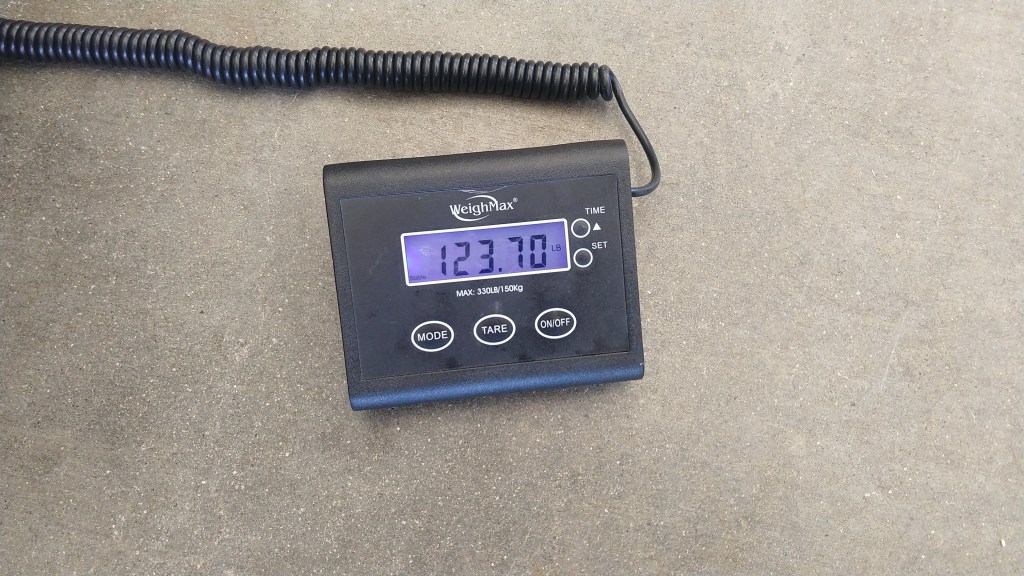
Despite what it may seem, Wednesday was not all trouble. We were able to get our shooting consistency and accuracy higher and we were also able to pre-inspect the robot. This led us to realizing part of our bumper attachment wasn’t legal and a quick fix was executed that same day. At the same time, we got to weigh the robot (for the first time after changing the plates on the shooter) and it came out underweight with a little bit of wiggle room.

Our robot weight before competition. The actual competition weight came out to 123.8 lbs.

After fixing these problems we did one final systems check right before we went to load-in. Everything worked as we wanted it and we were ready for competition.

Our final systems check before the Del Mar Regional.

Design a site like this with WordPress.com
Get started